
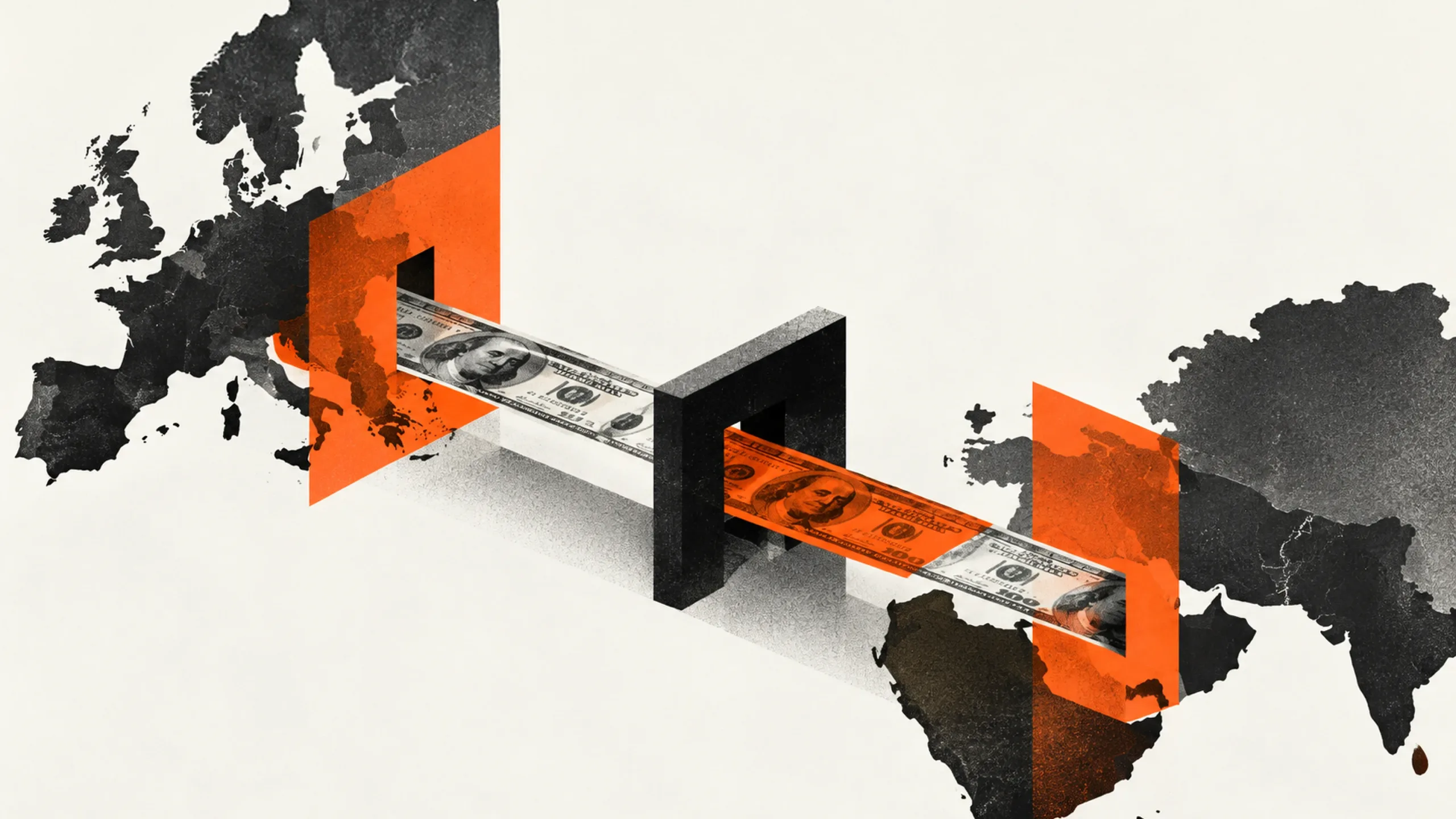
Between 2007 and 2015, around €200 billion moved through the Estonian branch of Danske Bank, much of it from non-resident customers in Russia and other former Soviet states. A large share was later judged suspicious. The money arrived from one set of countries, passed through accounts in Estonia, and left for companies registered in the UK, Cyprus, the British Virgin Islands and elsewhere.
In December 2022, Danske Bank pleaded guilty in the United States and agreed to forfeit around $2 billion.
The case shows something every financial crime investigator learns quickly: money moves across borders in seconds, while the evidence needed to follow it stays stuck in separate jurisdictions. Cross-border money laundering investigations exist to bridge that gap.
Why international money laundering is so hard to detect
The United Nations Office on Drugs and Crime estimates that between 2% and 5% of global GDP is laundered every year, somewhere between $800 billion and $2 trillion. Only a small fraction is ever detected, and cross-border flows are a big reason why.
Each border adds a layer of difficulty:
- Different registries. Company ownership information is public in some countries, restricted in others, and simply unavailable in a few.
- Different laws. What counts as suspicious, and what a bank must report, varies by jurisdiction.
- Different languages and record systems. Court records, property registries and adverse media may only exist locally.
- Fragmented visibility. Each bank only sees its own part of the transaction chain. No single institution sees the whole journey.
- Slow formal cooperation. Requests for information between governments can take months or years.
Launderers know this. They deliberately route funds through several jurisdictions, because every extra border makes the trail harder and slower to follow.
Common cross-border laundering methods
Shell companies in secrecy jurisdictions
Companies with no real operations, often owned through nominees or other companies, used to hold accounts and disguise who controls the money.
Correspondent banking
Banks that hold accounts for other banks allow money to move internationally. When the respondent bank has weak controls, illicit funds can enter the global system through it.
Trade-based money laundering
Value is moved by over- or under-invoicing goods, invoicing for goods that never ship, or describing goods falsely. The money looks like normal trade payments.
Back-to-back loans and fake disputes
Funds are moved under the cover of loans that are never meant to be repaid, or through staged court disputes that order one company to pay another.
Crypto and alternative remittance
Cryptocurrency, informal value transfer systems and money service businesses can move value across borders outside the traditional banking system, or between it and the crypto world.
How money laundering investigations trace illicit funds across borders
Cross-border money laundering investigations follow a disciplined process. The tools vary from case to case, but the logic is consistent.
1. Establish the starting point
Investigators begin with what’s known: a suspicious transaction, a set of accounts, a company, or a person. The aim is to understand where the money came from and what the legitimate explanation is supposed to be.
2. Map the transaction chain
Using bank records, payment data and, where crypto is involved, blockchain analysis, investigators reconstruct how funds moved: from which account, through which intermediaries, to which destination. Each hop is a lead.
3. Identify the real owners at each step
Every company in the chain is researched in its home jurisdiction. Who are the directors and shareholders? Are they nominees? What other companies share the same address, agent or officers? This is where international money laundering schemes usually start to unravel, because the same names, agents and addresses keep reappearing.
4. Test the commercial story
If payments are described as trade, investigators check whether the goods, shipments and counterparties are real. If they’re described as loans or consultancy, they check whether the terms make commercial sense.
5. Search locally, in local languages
Litigation, insolvency records, property ownership, regulatory actions and press coverage are searched in each relevant country. Some of the most useful evidence only exists in local-language sources.
6. Trace to assets
The final step is identifying where the value ended up: property, companies, luxury assets, investment accounts or crypto wallets. This is what makes recovery, freezing orders and enforcement possible.
What makes money laundering detection work across borders
The cases that succeed tend to share a few things:
- Investigators with on-the-ground reach in the jurisdictions involved, not just database access
- Speed, because the chance of freezing funds drops sharply once they’ve moved on
- Strong evidence handling, so findings can support civil claims, regulatory reports or criminal referrals
- Combined expertise in financial analysis, corporate records, OSINT and blockchain tracing
- Coordination with lawyers, who can use findings to apply for disclosure and freezing orders in the right courts
When to bring in a specialist
Financial institutions, corporates and law firms typically need specialist support when:
- Transaction monitoring flags flows involving several high-risk jurisdictions
- A customer’s ownership structure can’t be resolved from public registries
- Funds have been lost to fraud and need tracing before they disappear
- A regulator or correspondent bank is asking questions about past activity
- Litigation or asset recovery depends on proving where money went
How CAT Investigators can help
CAT Investigators conducts money laundering investigations and wider financial crime investigations for banks, fintechs, crypto businesses, corporates and law firms. With teams in New York, London and Hong Kong and a global network of investigators, we trace funds across jurisdictions, identify beneficial owners behind complex structures, analyze blockchain activity and locate assets, with evidence built to support legal and regulatory action.
When money crosses borders, the investigation has to as well.
Talk to our financial crime investigators
This article is for general information and does not constitute legal advice.