
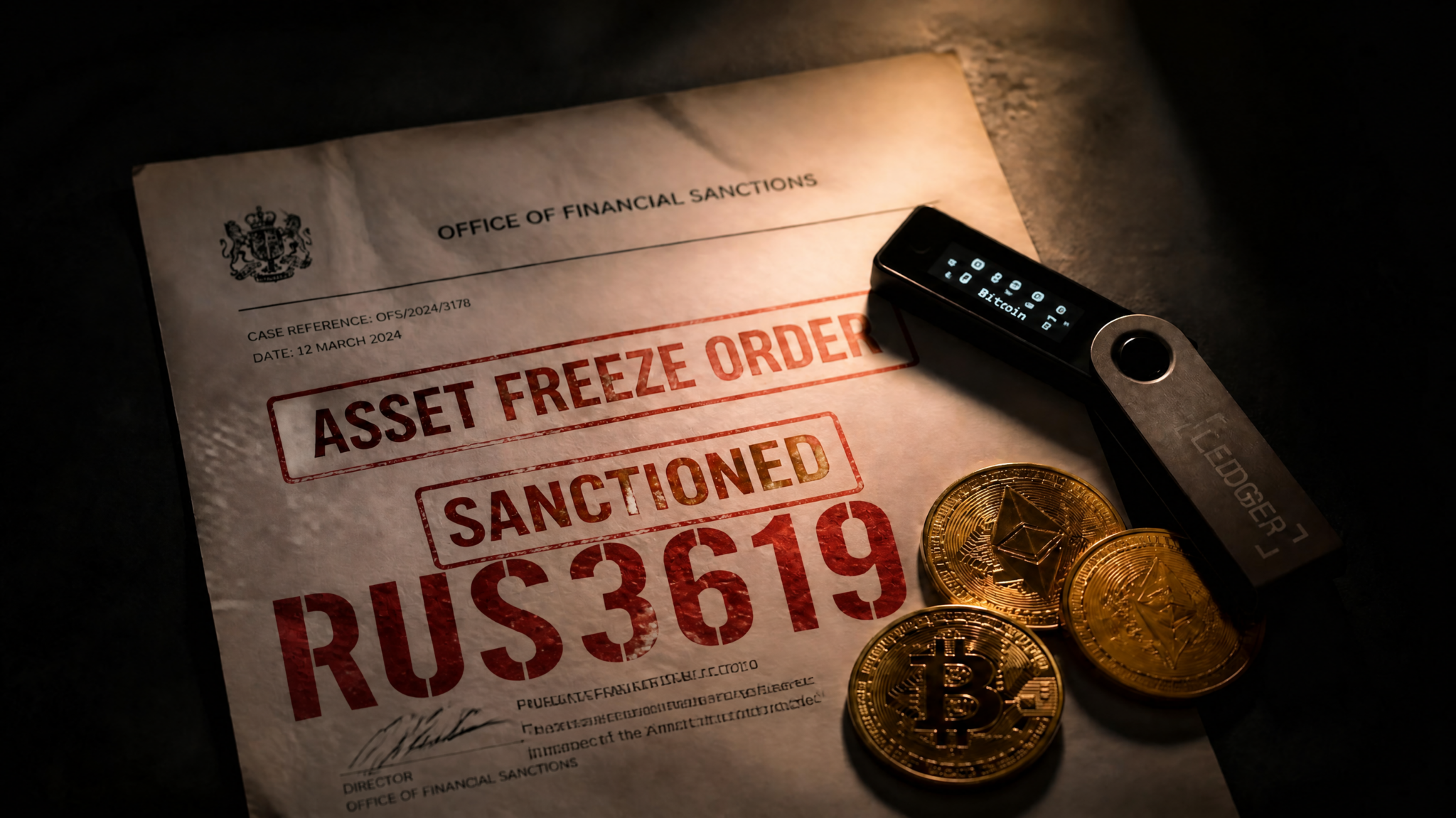
A new UK sanctions package goes after the Kremlin-linked A7 crypto‑banking network. It freezes a Kyrgyz bank and designated entities like RUS3619, which sit at the core of Russia’s sanctions‑evasion machinery.
How UK Sanctions Treat the A7 Crypto Network as Critical Infrastructure
On 26 May 2026, the UK government announced a new package of Russia‑related sanctions. The package targets cryptocurrency platforms, regional banks and financial intermediaries it identifies as “shadow financial systems” supporting Moscow’s war economy. At the same time, it updated the UK Sanctions List under The Russia (Sanctions) (EU Exit) Regulations 2019.
The measures focus on a Kremlin‑linked structure described as the A7 network. They also cover a Kyrgyz bank and associated entities. According to officials, these parties route funds for Russia outside traditional correspondent‑banking channels. In addition, they help finance procurement in spite of Western restrictions.
From the date of designation, UK jurisdiction freezes all funds and economic resources of the listed parties. Furthermore, UK persons may not make funds or economic resources available to them, directly or indirectly. The only exception is a granted license.
This action builds on earlier UK measures in August 2025 that first publicly named the A7 ecosystem. At that point, London designated a Kyrgyz institution (Capital Bank) and its director Kantemir Chalbayev. It also designated several Russia‑facing cryptoasset exchanges for facilitating ruble‑linked transactions designed to circumvent sanctions.
At that time, UK and partner reporting highlighted a ruble‑backed token associated with A7. That token had processed roughly 9.3 billion USD in transactions over four months on a dedicated exchange. This figure underscores the scale of flows moving through these alternative rails rather than through conventional banking.
What the May 2026 UK Sanctions Package Adds
The May 2026 package goes further. It does not treat A7 as a single token or platform. Instead, it views A7 as a piece of core infrastructure for Russia’s financial resilience. As a result, it tries to cut multiple points in the network in one coordinated move. These points include exchanges, banks and vehicles registered in jurisdictions such as Kyrgyzstan, Georgia and the UAE.
In the technical architecture of sanctions, new entries on the UK Sanctions List reflect these decisions. They include the designation with identifier RUS3619 under the Russia regime. The public record for RUS3619 specifies the regime, list type and designation date (26 May 2026). It confirms that RUS3619 is now an asset‑freeze target. Therefore, banks, funds, insurers and digital‑asset platforms must capture it when screening payments, relationships and onboarding flows.
Why A7 Changes How UK Sanctions Risk Shows Up in Files
For CAT Investigators’ clients, the A7 action is less a single sanctions headline and more a case study. It shows how regulators now map and attack Russia’s sanctions‑evasion infrastructure at the network level.
The UK is signalling that ruble‑linked tokens, regional banks in jurisdictions like Kyrgyzstan and Russia‑facing exchanges are not marginal anomalies. On the contrary, they are deliberately constructed payment rails. Authorities can trace, designate and cut them when they support the Kremlin’s war machine.
In practical terms, sanctions exposure increasingly appears through repeated contact with a tight cluster of intermediaries. These include banks, OTC brokers, exchanges and shell entities tied to A7‑type systems. Such contact matters as much as direct dealings with well‑known Russian SOEs, defense firms or oligarch names.
Network Patterns Behind Sanctions Exposure
The A7 case also exposes the limits of static, name‑only screening architectures.
Consider the numbers. A ruble‑backed token can move 9.3 billion USD in four months. Meanwhile, a single global exchange‑plus‑bank corridor can channel more than 1.5 billion USD in flows linked to Russian interests. All of this can happen before anyone publicly calls it out. For UK sanctions screening, the principal risk is not one missed sanctions‑list “hit” but the absence of structural pattern recognition across counterparties and channels.
Forensic analysis therefore needs to connect dots across jurisdictions and asset classes. Warning signs include recurring use of Kyrgyz banks, ruble‑pegged tokens and specific Russia‑facing exchanges. Similarly, vehicles registered in hubs like the UAE or Georgia point to network‑level exposure to A7‑style systems. That remains true even before regulators formally designate every individual node. Our digital and financial forensics team applies this kind of cross-border analysis.
Some institutions sit at the crypto‑traditional finance boundary. For them, the 26 May UK sanctions notice and the RUS3619 listing work as a live test. The question is whether their sanctions‑risk architecture can keep pace with this shift toward distributed, token‑enabled evasion networks.
Going forward, regulators will judge compliance teams less on whether they block obviously named actors. Instead, the focus will be on whether teams can identify, escalate and, where necessary, exit relationships structurally entangled with A7‑type networks. This holds even when only a subset of nodes, like RUS3619, currently appear on official lists.
UK Sanctions Compliance: Where to Focus and What Not to Miss
- Re‑tool sanctions models around A7‑type indicators: Integrate the specific jurisdictions, ruble‑linked token behavior and Russia‑facing exchanges from the UK materials into sanctions‑risk scoring. Then flag clients or counterparties that repeatedly touch this cluster for enhanced due diligence.
- Hard‑wire the new UK listings, including RUS3619: Confirm that screening engines pull the latest UK Sanctions List and Russia‑regime updates. After that, test whether your controls detect, block or escalate payments, relationships and trades involving RUS3619 or linked entities. Each response should follow asset‑freeze obligations.
- Build playbooks for crypto‑banking corridors: Develop dedicated investigative workflows for cases involving ruble‑anchored tokens, Kyrgyz or similar regional banks and Russia‑facing exchanges. Include criteria for filing suspicious activity reports, exiting relationships or seeking legal advice on licensing where UK sanctions may apply.
- Re‑screen high‑risk books for hidden A7 exposure: Some existing clients have a known Russian nexus or elevated sanctions risk. For those clients, run a retrospective review of transaction histories to identify repeat touchpoints with A7‑type infrastructure. Finally, escalate those cases for targeted financial crime investigation and, where appropriate, engagement with UK or allied enforcement partners.
If your team needs support reviewing exposure to UK sanctions, our KYC and AML compliance specialists can help.
Sources
- Reuters – “UK targets Russian crypto networks in latest sanctions”
- UK Government news release – “UK cracks down on backdoor Russian sanctions evasion with tough new measures”
- UK Sanctions List landing page
- UK Sanctions List entry – RUS3619 (Russia regime)
- Sanctions Notice, Russia (26 May 2026)
- UK Government background – “UK targets sanctions circumvention and crypto networks exploited by Russia”