

U.S. authorities have taken coordinated action against Xinbi Guarantee, a Chinese-language illicit marketplace allegedly used to enable cyber-enabled fraud, cryptocurrency laundering, and the operation of scam compounds. The case is a notable example of how enforcement agencies are increasingly targeting not only the fraudsters themselves, but also the online infrastructure and financial-service layers that allow industrial-scale scams to operate.
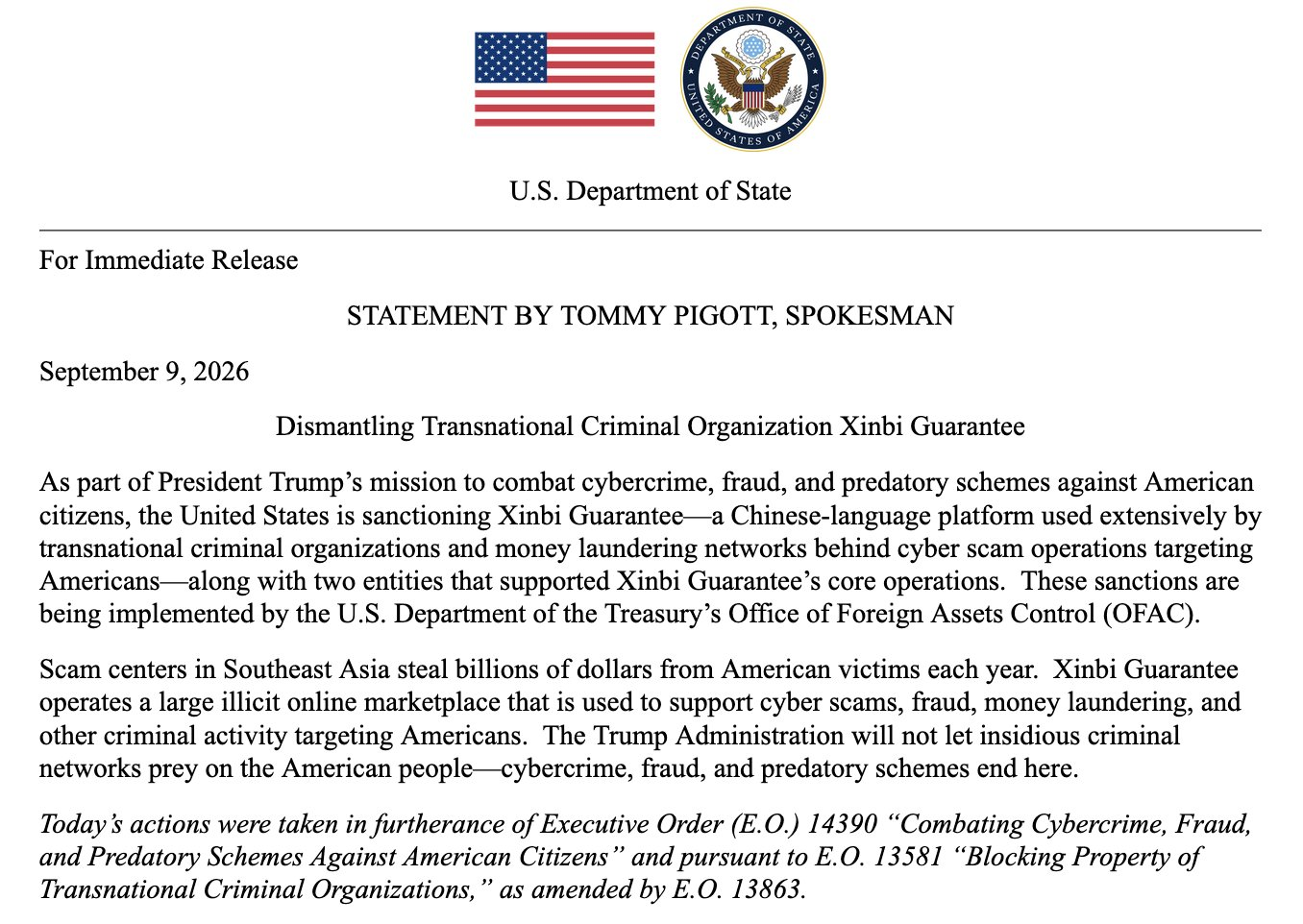
On September 9, 2026, the U.S. Department of Justice’s Scam Center Strike Force announced seizures connected to Xinbi, while the Treasury Department’s Office of Foreign Assets Control (OFAC) designated it a significant transnational criminal organization. The action included the seizure of Telegram channels used by the marketplace, two cryptocurrency wallets, and the restraint of more than $52 million in crypto assets linked to Xinbi and associated vendors.
A marketplace for scam operations
According to the DOJ, Xinbi operated primarily through Chinese-language Telegram channels.
Vendors allegedly advertised a broad range of services to scam-center operators: fraudulent investment websites, crypto “cleaning” or laundering services, recruitment of personnel for scam compounds, and other operational support.
The alleged business model resembled an escrow marketplace.
Xinbi reportedly held funds until a vendor completed the service purchased by a scam operator, reducing counterparty risk within the criminal ecosystem. This is an important detail: it suggests that the platform was not merely a communications channel, but a coordination and payment layer that helped professionalize criminal service delivery.
For investigators, such marketplaces create high-value disruption points. They can connect infrastructure providers, laundering vendors, recruiters, wallet services, and scam operators in one environment making it possible to map relationships that may otherwise remain fragmented across separate Telegram groups, wallet clusters, and jurisdictions.
Crypto tracing at the core
This enforcement effort underscores how crucial blockchain intelligence has become in dissecting sophisticated fraud networks. Federal prosecutors noted that victim capital was mapped directly to service providers offering laundering options inside Xinbi channels, which publicly listed wallet addresses for settlement.
A pair of primary addresses utilized by the platform for fee collection contained approximately $12 million, prompting federal agents to pursue the freezing of 47 supplementary wallets tied to affiliated money movers and merchants.
Furthermore, the inquiry highlights why on-chain address mapping must remain a dynamic discipline. Addresses linked to underground networks fulfill distinct operational tasks: absorbing illicit funds, harvesting administrative cuts, securing escrow balances, compensating contractors, executing cross-chain transfers, or funneling assets into liquid exchanges and private brokers.
Mapping these specific operational roles offers far deeper analytical utility than simply tagging an address as high risk.
The economic sanctions applied by OFAC introduce significant regulatory compliance duties. American citizens and firms are barred from engaging with sanctioned targets, requiring any assets falling under domestic jurisdiction to be frozen and disclosed.
Regulatory enforcement extended to two corporate entities charged with bolstering Xinbi’s infrastructure, demonstrating a clear willingness by regulators to target supporting commercial networks alongside the primary platform.
A wider scam-center response
The intervention against Xinbi represents a single element in an expanded American campaign targeting syndicated fraud facilities tied to East Asian criminal rings, particularly those operating across Southeast Asia.
Disclosures from the Strike Force confirmed active collaboration with law enforcement in Madagascar to neutralize 13 Asian-managed fraud compounds, supporting the forensic analysis of over 3,200 hardware units and processing interviews following nearly 400 detentions.
Such organized syndicates primarily execute deceptive investment schemes, commonly described as romance-based financial fraud.
The magnitude of financial damage suffered by victims is immense: federal reporting from the FBI IC3 demonstrates that recorded losses stemming from crypto investment schemes surged from $4.57 billion throughout 2023 up to $8.65 billion by 2025.
Compliance implications
For digital asset exchanges, stablecoin issuers, virtual financial providers, and traditional institutions, these enforcement actions deliver several operational priorities:
- Continuously screen for exposure to designated wallet groups, intermediary vendors, and connected downstream addresses – extending beyond explicitly listed identifiers.
- Analyze operational signals including swift fund layering, stablecoin conversions, inter-chain bridging, reliance on unlisted liquidity providers, and transfer rhythms consistent with escrow settlements.
- Incorporate encrypted messaging commercial activity into investigative open-source intelligence frameworks whenever legally permitted.
- Escalate overlapping signals linking stolen proceeds, scam compound networks, and labor exploitation indicators rather than evaluating each threat vector independently.
Dismantling Xinbi Guarantee will not instantly eliminate the broader fraud-compound sector.
Nevertheless, it reflects a far more sophisticated enforcement blueprint: pairing on-chain tracing, chat seizures, financial blocking, cross-border partnerships, and targeted legal moves against the operational service layers that make systemic financial crime feasible.
For compliance leaders and chain analysis specialists, the core lesson stands out-following transactional footprints remains vital, but dismantling the supporting infrastructure that enables, launders, and sustains those flows is where impactful cases are ultimately won.