

James Zhong stole 50,676 Bitcoin from the Silk Road marketplace in 2012. He exploited a flaw in the platform’s withdrawal system, tricking it into paying him more than he deposited. By the time of seizure, the haul was worth $3.36 billion. For years, those hidden assets seemed out of reach.
He didn’t put it in a bank. There were no brokerage statements, no offshore trust documents, and no paper trail in the conventional sense at all. Instead, he split the funds across wallets and moved them gradually over years. He also stored the private keys on a device hidden inside a popcorn tin, buried under blankets in a bathroom closet.
Nine years later, federal agents stood in that bathroom and found it anyway.
What got him wasn’t a confession or a tip. Chainalysis, tracing the wallets containing the stolen funds, caught the hacker making a small mistake. He sent around $800 to a cryptocurrency exchange that followed standard know-your-customer procedures. That exchange required a real name and address, and the account belonged to Zhong. In other words, one transaction out of thousands connected a decade-old digital crime to a real identity. As U.S. Attorney Damian Williams put it at the time: “We won’t stop following the money, no matter how expertly hidden, even to a circuit board in the bottom of a popcorn tin.”
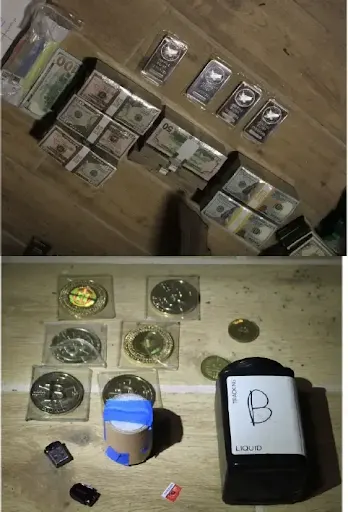
Physical bitcoin and cash investigators found during the search warrant of Zhong
Source: IRS Criminal Investigations

The popcorn tin where investigators found a single board computer hidden inside
that held millions of dollars worth of bitcoin.
Source: IRS Criminal Investigations
That case captures something most people who try to hide assets fundamentally misunderstand. They believe a clean paper trail and a sophisticated structure will be enough. In reality, investigations into hidden assets almost always surface a behavioral and documentary footprint. The right combination of forensic accounting and investigative methodology consistently surfaces concealed wealth. It does so no matter how long ago someone concealed it.
Why Hidden Assets Are Never as Hidden as People Think
The fundamental flaw in every concealment strategy is the same: hiding money requires action, and action leaves records.
Moving funds between accounts creates a transaction record. Setting up a shell company creates a filing. Buying property under someone else’s name creates a deed. Similarly, converting cash into cryptocurrency creates a blockchain entry that will exist permanently. There is no version of hiding wealth that doesn’t require doing something. Every one of those somethings is potential evidence.
This is why experienced forensic investigators treat the act of concealment itself as a data point, not just an obstacle. The complexity of a structure built to hide money is often the clearest signal that there’s something worth finding. After all, nobody builds an elaborate, multi-layered ownership structure to protect assets that don’t exist or that wouldn’t survive scrutiny if found. The effort is the tell.
The myth of the perfect hiding place persists for a simple reason. Most people who attempt it have never been the subject of hidden asset tracing by someone who actually knows what they’re looking for. Zhong believed splitting his Bitcoin across multiple wallets and waiting years before moving it would be enough. It nearly was. But “nearly” and “permanently” are very different outcomes. The gap between them is exactly where asset tracing investigations and forensic investigations operate.
Where Hidden Assets Typically Surface
Asset tracing investigations aren’t a niche specialty reserved for unusual cases. Instead, they’re a recurring need across some of the most common categories of dispute and investigation.
High-net-worth divorce and matrimonial disputes are among the most frequent contexts for divorce asset tracing. In these matrimonial investigations, some individuals attempt to hide assets to reduce their financial obligations. Common tactics include transferring funds to offshore accounts, underreporting income, or purchasing assets in another person’s name. Several indicators warrant deeper investigation. These include unexplained lifestyle changes that don’t match reported income and sudden transfers to family members or friends. Complex investment portfolios with offshore components and undisclosed cryptocurrency holdings are also warning signs.
Hidden Assets in Corporate, Tax and Shareholder Cases
Corporate fraud and inflated or concealed liabilities represent another major category. Here, executives or business owners misstate the financial position of an entity to mislead investors, lenders, or regulators. Embezzlement investigations follow a similar logic in reverse. Someone has been quietly diverting funds, and the question is where those funds ultimately landed.
Tax evasion cases depend almost entirely on asset tracing investigation methodology. The core question is whether declared income and assets match the reality of what someone actually controls. Likewise, business or shareholder disputes frequently turn on whether one party has concealed value. That value may sit in undisclosed side agreements, hidden profit distributions, or assets quietly moved out of a jointly held entity before a dispute became formal.
Across all of these contexts, the investigative principle is identical. Someone has structured their financial life to present one picture while a different reality exists underneath it. The job is to find where those two pictures diverge.
The Financial Document Trail Behind Hidden Assets
Every hidden asset investigation starts with the conventional paper trail. Even sophisticated concealment usually leaves gaps in the basic documentation.
Tax returns are often the first document investigators review. They rarely reveal hidden assets directly, but they establish a baseline. What someone reports to tax authorities should be internally consistent with their bank statements, credit card records, and business ledgers. When it isn’t, that inconsistency is the starting point for deeper investigation.
Lifestyle Analysis and Property Records
Lifestyle analysis is one of the most consistently productive techniques in hidden asset tracing. Investigators assess spending habits, property ownership, and luxury purchases. The goal is to identify discrepancies between reported income and actual expenditures. Consider a spouse who claims to have little money but consistently spends on luxury goods, vacations, or dining. That pattern signals hidden assets or undisclosed income just as clearly as a financial document would.
Forensic accountants typically reconstruct a subject’s actual income by analyzing bank deposits, canceled checks, and currency transactions. At the same time, they account for cash payments, gifts, and other non-income sources. These might explain a lifestyle that otherwise doesn’t add up.
Real estate records and ownership history provide another reliable layer in any asset tracing investigation. This is because most jurisdictions record property transactions publicly. Even ownership disguised through a relative’s name or a holding entity still leaves a traceable chain. Contracts and agreements, when reviewed carefully, frequently reveal undisclosed relationships or obligations. These don’t appear anywhere in a balance sheet. One example is a side agreement that shifts profit distributions. Another is a consulting arrangement that exists primarily to move money rather than provide a service.
Following Hidden Assets Through Corporate Structures
When concealment moves beyond personal finances into corporate structures, the investigative methodology shifts. However, the underlying logic stays the same: complexity creates more points of connection, not fewer.
Investigators review corporate filings for shared addresses, overlapping signatures, and common registered agents. This is one of the most effective ways to connect entities that appear unrelated on the surface. People hiding assets through multiple companies frequently reuse the same formation agents or registered office addresses. Many also rely on the same small circle of nominee directors. After all, building entirely separate infrastructure for every entity is expensive and impractical. Those shared details become the thread that connects them, which is why enhanced due diligence and UBO research matter so much.
Offshore Structures and Disguised Payments
Many people assume offshore jurisdictions are impenetrable, but secrecy and impenetrability are not the same thing. Offshore structures slow down an investigation. However, they rarely stop one entirely. This is especially true with international information-sharing agreements and local counsel. The kind of patient cross-border work that experienced investigators specialize in also helps.
Wire transfers disguised as consulting fees, management charges, or foreign loans are a recurring pattern in corporate concealment cases. The payment itself looks legitimate on a bank statement. What exposes it is the absence of anything behind it. There is no contract that justifies the fee and no deliverable that corresponds to the consulting arrangement. Nor is there loan documentation that would hold up if anyone asked to see it.
Shell companies and circular ownership structures exist to obscure who actually benefits. In a circular structure, Entity A owns Entity B, which owns Entity C, which somehow owns a stake in Entity A. Untangling them is methodical work. Still, once mapped, the structure itself usually makes its own purpose obvious.
The Digital Layer
Modern asset tracing investigations increasingly run through digital evidence. This is where investigators have gained the most ground in recent years.
Computer forensics can recover deleted files, reconstruct browser history, and surface electronic communications that someone believed were gone. For example, a deleted email about a side account can become part of the evidentiary record. So can a search history showing research into offshore banking, or a messaging thread discussing how to structure a transfer. This holds true even when the person involved assumed those records no longer existed.
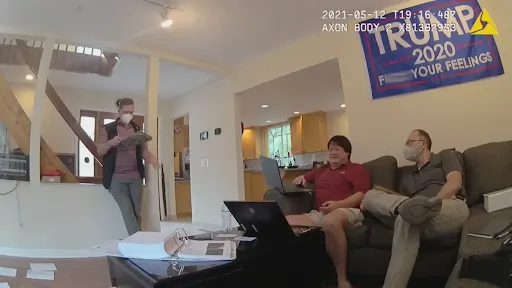
Body camera footage CNBC obtained captures Zhong showing investigators millions of dollars of bitcoin on his laptop.
Source: Athens-Clarke County Police
Cryptocurrency and Hidden Assets
Cryptocurrency has become one of the most significant modern concealment vehicles. It is also one of the most consistently misunderstood contexts for hidden asset tracing. Investigators can track the location of cryptocurrency on the blockchain, which is a public ledger of all transactions. This means the record of where funds moved exists permanently and doesn’t require a subpoena to access.
The Zhong case is the clearest illustration available. A decade passed between the theft and the seizure. Yet the blockchain record was just as available on day one as on the day investigators finally connected it to a real name. As Chainalysis noted in its review of the case, the blockchain is forever. Investigators can therefore always return to old, suspicious transactions and investigate them using the latest methods. This remains true even when criminals go to great lengths to hide their activity, and even when years have passed. Our guide on how investigators follow crypto money explains this process in more detail.
Modern asset tracing services and forensic accounting also rely heavily on advanced software tools and data analytics. These tools process large volumes of financial data quickly. As a result, they identify patterns, correlations, and anomalies that manual review alone could not realistically detect. What once took weeks of manual reconciliation can now surface through automated analysis in a fraction of the time. This frees investigators to focus on interpreting what the data shows rather than spending most of an engagement simply assembling it.
The Challenges Investigators Actually Face
None of this is to suggest asset tracing is simple. It isn’t, and the honest challenges are worth naming.
Lack of cooperation from the individual or entity under investigation is the most consistent obstacle. People who have gone to the trouble of hiding assets rarely volunteer documentation that would expose them. As a result, investigators frequently need legal mechanisms such as court orders or subpoenas. These give access to records that would otherwise stay out of reach.
Technology, Time and Jurisdiction
Rapidly evolving technology, including blockchain and increasingly sophisticated digital concealment tools, adds another challenge. The investigative toolkit has to keep pace with methods that didn’t exist a few years ago. The same permanence that makes blockchain such a powerful evidentiary record has a flip side. People using it to hide assets are getting more sophisticated about layering transactions and hopping between chains. Some also use privacy-focused tools designed specifically to frustrate tracing efforts.
Resource and time constraints are a real limitation in complex, multi-jurisdictional cases. Tracing assets across several countries takes time and sustained effort. Each country has different legal frameworks, disclosure requirements, and levels of cooperation with foreign investigators. Some cases that are ultimately winnable simply require more runway than a client or a court timeline can accommodate.
These challenges are real. They’re also exactly why the combination of forensic accounting expertise and investigative methodology matters more than either discipline operating alone. The financial analysis identifies where the inconsistencies are. Then, the investigative work establishes who’s actually behind them. It also builds the documented case needed to act on it.
The Trail to Hidden Assets Is Always There
Hidden assets rarely stay hidden because of genius. Usually, the people hiding them simply believe complexity is the same thing as invisibility.
It isn’t. James Zhong built one of the most sophisticated concealment efforts cryptocurrency has ever seen. He split funds across wallets, waited years between transactions, and stored his keys somewhere no one would think to look. It held up for nearly a decade. However, it didn’t hold up forever. The single transaction that finally connected the funds to his identity had been sitting on a public ledger the entire time. It was simply waiting for someone who knew how to read it.

Source: Zhong’s social media profile
That’s the pattern across nearly every hidden asset tracing case, regardless of scale. The trail is there. Finding it takes someone trained to recognize where to look. It also takes the patience to follow inconsistencies across documents and jurisdictions. Finally, it takes the methodology to turn a financial anomaly into a finding that holds up when it matters.
FAQs
What is asset tracing and when is it used?
Asset tracing investigations involve identifying, locating, and documenting wealth that someone has hidden, transferred, or disguised. Typical contexts include divorce settlements, corporate fraud investigations, embezzlement cases, tax evasion matters, and business or shareholder disputes. Asset tracing services combine forensic accounting techniques with investigative methodology. The goal is to establish where money or assets actually are, as opposed to where financial records claim they are.
How do forensic accountants find hidden bank accounts?
Forensic accountants typically start by reconstructing a subject’s actual financial position. To do this, they use bank record analysis, tax return review, and lifestyle analysis comparing reported income to actual spending. Discrepancies between declared income and real-world spending often point toward accounts or assets that haven’t been disclosed. So do unusual transfers, undisclosed business relationships, or inconsistencies across financial documents. For this reason, this work is a core component of any hidden asset investigation.
Can cryptocurrency assets be traced and recovered?
Yes. A public blockchain records cryptocurrency transactions permanently. As a result, the movement of funds remains traceable indefinitely through hidden asset tracing methodology, regardless of how much time has passed. Recovery becomes possible once investigators can connect a wallet address to a real identity. This often happens when funds eventually pass through a regulated exchange that requires identity verification. The James Zhong case demonstrates how durable this kind of evidence is. There, investigators traced and recovered $3.36 billion in Bitcoin nearly a decade after the original theft.
What role does lifestyle analysis play in asset tracing investigations?
Lifestyle analysis is a foundational technique in divorce asset tracing and corporate hidden asset investigations alike. It compares an individual’s reported income against their actual spending, including property ownership, vehicles, travel, and other discretionary expenses. Sometimes a person’s lifestyle significantly exceeds what their declared income could support. That gap is a strong indicator of undisclosed income or concealed assets. It also gives investigators a specific area to focus deeper financial scrutiny.
How long does an asset tracing investigation typically take?
Timeline varies significantly based on the complexity of the concealment and the number of jurisdictions involved. It also depends on the level of cooperation from the individual or entity under investigation. Straightforward asset tracing investigations involving domestic accounts and basic lifestyle discrepancies can take weeks. By contrast, cases involving offshore structures, shell companies, or cryptocurrency spanning multiple jurisdictions can take considerably longer. Sometimes they take years, particularly when investigators need legal mechanisms like subpoenas or international cooperation to access records.
What challenges do investigators face when tracing concealed assets?
The most consistent challenges in hidden asset investigations fall into three groups. First, the subject often refuses to cooperate. Second, digital concealment tools keep growing more sophisticated, including blockchain-based obfuscation techniques. Third, complex, multi-jurisdictional asset tracing investigations face resource and time constraints. Each of these can slow an investigation considerably. Even so, none of them make a well-documented financial trail permanently unrecoverable.
How does CAT Investigators approach asset tracing cases?
Work With CAT Investigators to Trace Hidden Assets
CAT Investigators provides specialist asset tracing services USA and internationally. We combine forensic financial analysis with field investigation to trace concealed assets across personal, corporate, and cross-border contexts. Our hidden asset investigation work includes lifestyle analysis, corporate structure mapping, offshore asset tracing investigations, and cryptocurrency forensics. We pair this with the legal and investigative groundwork needed to convert financial findings into evidence that holds up in court or negotiation. You may suspect concealment in a divorce asset tracing matter, a business dispute, or a fraud case. Either way, the sooner an investigation begins, the more of the trail remains intact. Contact us for a confidential consultation.
Sources
- U.S. Attorney Announces Historic $3.36 Billion Cryptocurrency Seizure And Conviction In Connection With Silk Road Dark Web Fraud
- Department of Justice Announces Second-Largest Ever Crypto Seizure, with $3.36 Billion in Bitcoin Seized from Silk Road Hacker
- Wikipedia
- Following the Money Trail: Asset Tracing and Financial Concealment
- How Forensic Accountants Track Down Hidden Assets
- Tracing Hidden Assets: How Forensic Accountants Follow the Money
- How Does a Forensic Accountant Find Hidden Assets
- How Forensic Accounting Can Detect Hidden Assets