
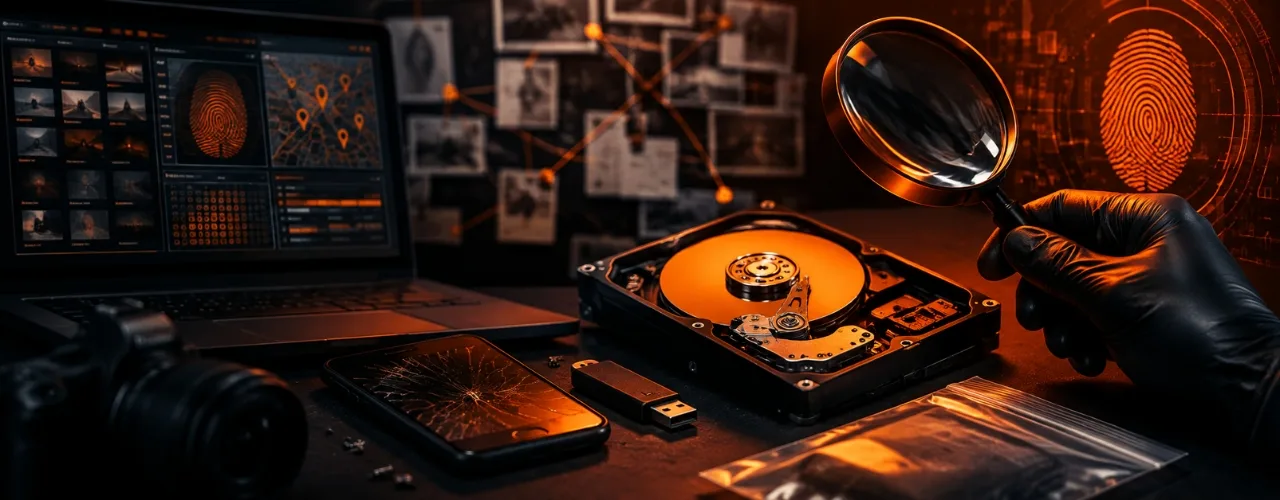
Most people assume that deleting something makes it gone. In digital forensic investigations, that assumption is one of the most consistent mistakes investigators encounter, and one of the most useful.
In complex cases involving fraud, corporate misconduct, criminal defense, or financial crime, the digital layer frequently holds the most critical evidence. Whether it’s recovering deleted emails, tracing IP addresses, or analyzing metadata from files, digital forensic investigations provide essential insights. Traditional investigative methods can’t replicate those insights.
And when that evidence changes the outcome, the other side usually believed they had already destroyed it.
What Digital Forensic Investigations Actually Are
Digital forensic investigations follow a structured process of identifying, preserving, analyzing, and presenting electronic evidence. Each step must meet legal standards. A computer forensic investigation isn’t the same as standard IT support or basic data recovery. The methodology matters as much as the findings. After all, digital evidence gathered without the right process won’t survive challenge in court, regardless of what it shows.
On average, a smartphone contains more than 60,000 messages, 32,000 images, and over 1,000 videos. It also holds documents, metadata, social media, emails, messaging platforms, and crypto wallets. That’s the scope of what properly conducted digital forensic services can access. Moreover, all of that comes before anyone has looked at cloud storage, email servers, or connected devices.
The starting point is forensic imaging: capturing an exact, verified copy of a device’s storage without altering the original. Examiners then document every action, timestamp every finding, and maintain the chain of custody from collection to courtroom.
Where Hidden Evidence Lives in Digital Forensic Investigations
Deleting a file typically doesn’t erase it immediately. Instead, the system marks the storage space it occupied as available for reuse. With the right tools and forensic expertise, investigators can often retrieve this digital evidence, even if new data has partially overwritten it. Text files, documents, emails, and images are among the most recoverable categories.
Metadata is equally important. Every file carries embedded information about its creation, modification, and access dates. It also records who authored it and, in many cases, the device’s location. Metadata analysis also identifies tampering. In fact, a document that looks straightforward on its face can tell a completely different story. The full picture emerges once a computer forensic investigation examines its underlying data.
By 2025, over 60% of newly generated data resides in the cloud. As a result, cyber forensic investigations increasingly require cross-platform, cross-jurisdictional data tracing. That work extends well beyond the physical device.
The Most Common Applications of Digital Forensic Investigations
Criminal Defense
Digital forensic investigations reconstruct timelines using metadata from devices, phone records, and location data. This can place individuals at specific locations at specific times. When digital evidence contradicts the prosecution’s account, the contradiction comes with a timestamp, and investigators can document it. In some cases, examiners can recover deleted content entirely. Meanwhile, social media forensics surfaces behavioral data that formal accounts may contradict.
Corporate Fraud and Internal Investigations
Internal fraud leaves a digital trail even when people take steps to cover it. Deleted emails, messaging threads, and browser history are all recoverable through a properly conducted computer forensic investigation. The same methodology also surfaces financial record discrepancies, unauthorized access, and documentation of who knew what and when. For this reason, digital evidence is central to modern corporate investigations.
Cryptocurrency and Blockchain Forensics
TRM’s crypto crime report showed illicit flows hit a record 158 billion USD in 2025. Every blockchain transaction sits permanently on a public ledger, leaving a forensic trail that skilled investigators can follow. Connecting cryptographic addresses to real-world identities requires clustering algorithms, machine learning-based pattern identification, and graph analysis. Together, these form the core toolkit of a cyber forensic investigation in the crypto space.
A recent case demonstrates what this looks like in practice. By correlating wallet flows with KYC identities, timing, and IP logs, investigators linked the flows to shell companies across eight exchanges. Combined with forensic analysis of email metadata and corporate records, it became a court-ready fraud narrative.
Why Methodology Matters as Much as the Finding
Digital evidence collected without forensic methodology is not the same as evidence collected properly. Qualified examiners generate hash values at the point of collection. They document their methodology in sufficient detail to withstand cross-examination. In addition, they maintain an unbroken chain of custody throughout the engagement.
Timing matters equally. Digital evidence degrades. Device logs reach their retention limits. Messaging app histories clear. The investigative options available in the days following an incident are substantially broader than those available weeks later. For this reason, speed and early engagement in digital forensic services produce their most significant returns.
When Digital Forensic Investigations and Traditional Investigation Work Together
Digital evidence rarely tells the complete story on its own. A blockchain trail shows where funds moved but not who moved them or why. Similarly, device logs show that someone accessed a file but not the human decision behind that access.
The most effective complex investigations combine digital forensic services with open-source intelligence, source interviews, field investigation, and financial analysis. Digital forensic investigations establish the digital facts. Traditional investigation, by contrast, establishes the human context. The combination produces findings that hold up when challenged.
The Evidence Was Never Really Gone
Digital evidence doesn’t disappear when someone hits delete. It waits in unallocated storage and in metadata nobody thought to check. It also sits in a blockchain record that has existed publicly since the transaction took place.
In most complex cases where digital forensic investigations change the outcome, everyone assumed the critical evidence no longer existed. It wasn’t gone. It just needed someone with the right methodology and tools to find it.
Does your case involve fraud, misconduct, financial crime, or criminal defense where digital evidence may be relevant? If so, the most important decision is how quickly an investigation begins.
FAQs
What is a digital forensic investigation?
A digital forensic investigation is the structured process of identifying, preserving, analyzing, and presenting electronic digital evidence in a legally defensible format. It covers devices, cloud storage, messaging platforms, email systems, and blockchain records.
What types of evidence can digital forensics recover?
Digital forensic services recover deleted files and communications, metadata, browser history, and application data. They also recover cloud storage contents, device logs, and blockchain transaction records.
Can deleted files really be recovered?
In most cases, yes. When someone deletes a file, the system marks the storage space as available rather than clearing it immediately. Computer forensic investigation tools can retrieve files from that space, provided new data hasn’t overwritten it.
How is digital evidence used in court?
Digital evidence is admissible when examiners gather it using proper methodology. That includes forensic imaging, hash value generation, documented chain of custody, and presentation by a qualified examiner.
How does CAT Investigators approach digital forensic investigations?
CAT Investigators provides specialist digital forensic services. These combine computer forensic investigation, cyber forensic investigation, blockchain and cryptocurrency tracing, social media forensics, and financial record analysis. We document every engagement to a standard that holds up in court, regulatory proceedings, or negotiation. Reach out for a confidential consultation.
Sources
- Top 6 Trends in Digital Forensics and Incident Response for 2025
- TRM’s New Crypto Crime Report Shows Illicit Flows Hit a Record USD 158B in 2025
- Key Trends in Digital Forensics 2025
- Future of Digital Forensics 2025
- Recovering Deleted Digital Evidence with Digital Forensics
- How to Recover Deleted Data for Legal Cases
- Blockchain Forensics 2025
- How Blockchain Forensics Unraveled a $20 Million Crypto Laundering Scheme in China
- Crypto Wallet Forensics: $40.9 Billion in Illicit Addresses