

FinCEN’s GENIUS Act CIP Proposal Set for Official Publication on 22 June 2026
FinCEN’s new GENIUS Act CIP proposal would force stablecoin issuers to adopt bank-style onboarding controls. The new joint proposal from FinCEN and four federal banking agencies would require permitted payment stablecoin issuers to verify customers. Issuers would also need to maintain written identification programs. In addition, they would have to document when to block onboarding or close accounts.
Stablecoins Just Got Treated Like Banks. Here's What That Means.
FinCEN, the OCC, the Federal Reserve, the FDIC, and the NCUA have jointly proposed a new rule. It would implement the GENIUS Act’s customer identification program requirement for permitted payment stablecoin issuers, or PPSIs.
The proposal would treat those issuers as financial institutions under the Bank Secrecy Act for customer identification purposes. Stablecoin onboarding would thus move closer to standards that already apply to banks and other regulated financial firms.
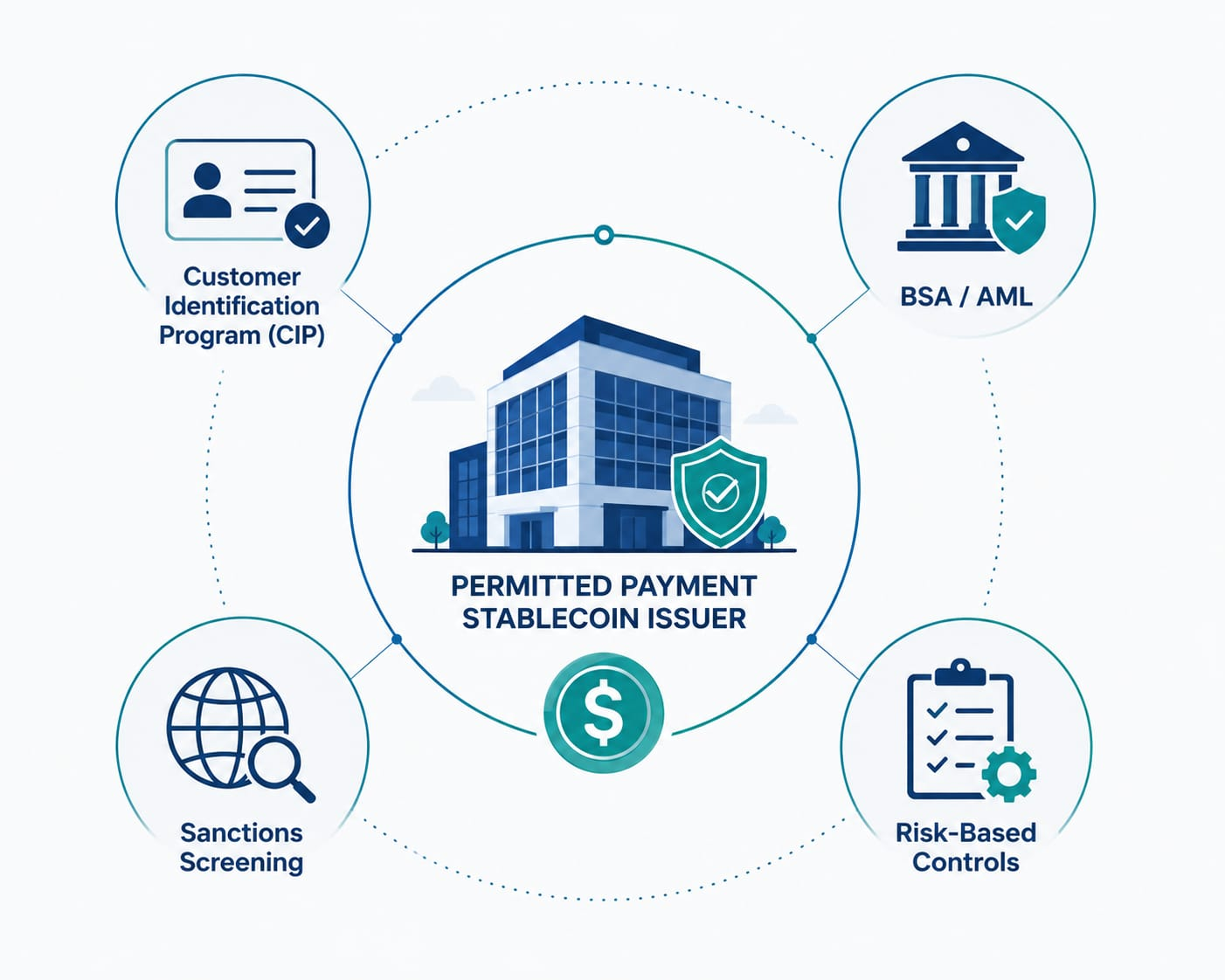
That shift matters because the GENIUS Act CIP proposal does not stop at a broad policy statement. Instead, it would require every PPSI to establish and maintain a written CIP tailored to its size and business. The rule would also require embedding that program inside its broader anti-money laundering and countering the financing of terrorism framework.
In practical terms, the GENIUS Act CIP rule would push stablecoin issuers toward formalized identity controls at the account-opening stage. Issuers could no longer rely on lighter money-transmitter style practices alone.
It's Not Just "Know Your Customer." It's How, When, and What Happens If You Don't.
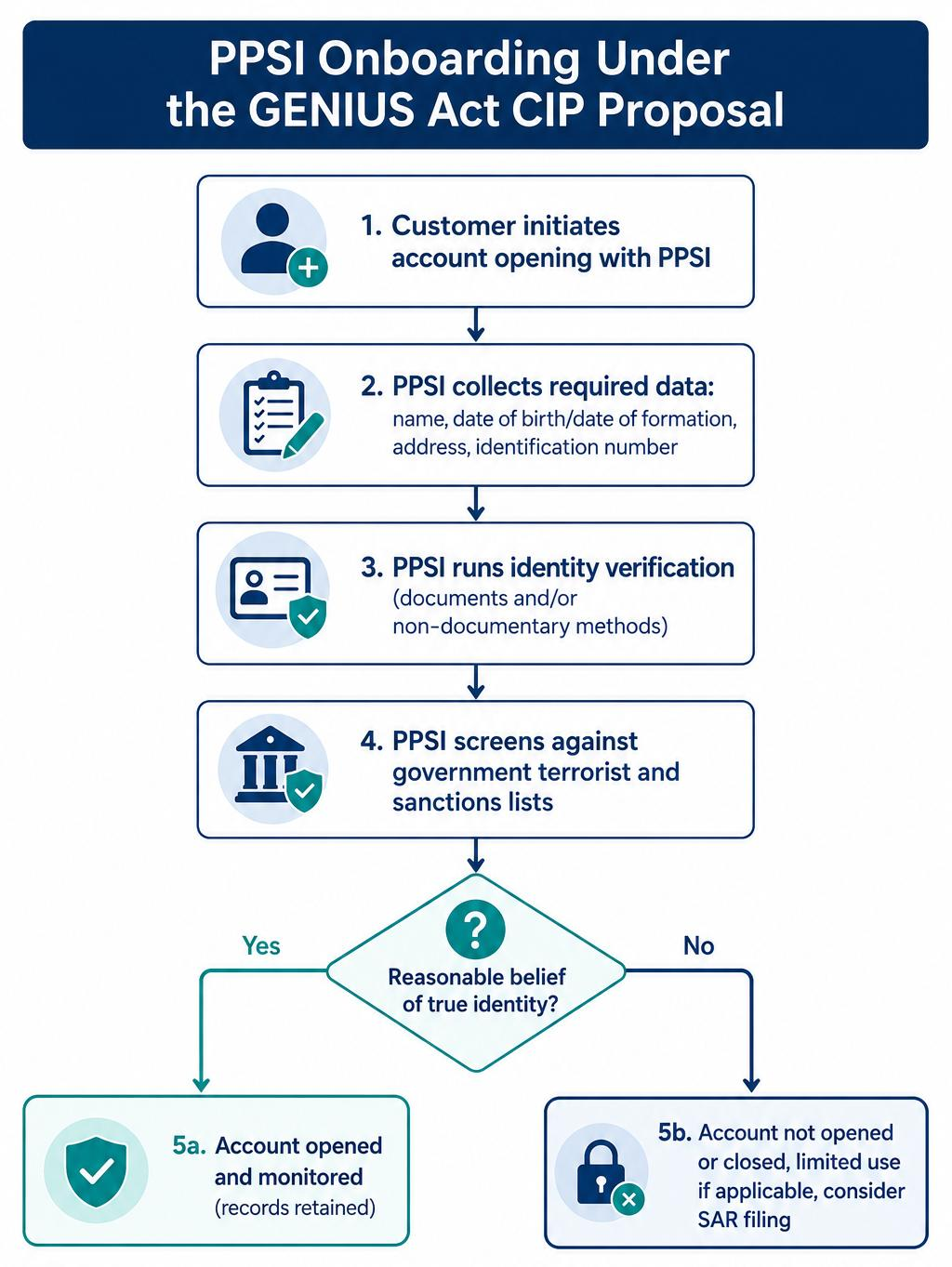
For compliance teams, the most important detail is not that customer identification is coming. Rather, it is how specifically the agencies propose to operationalize it. Before opening an account, a PPSI would need to collect a customer’s name, address, and identification number. It would also collect a date of birth for individuals or a date of formation for entities. Then, within a reasonable period after account opening, the issuer would need procedures to verify that identity. Verification could rely on documents, non-documentary methods, or a combination of both.
The proposal also goes further for entity customers. Where risk warrants it, a PPSI would need procedures for this step. Specifically, it would obtain information on individuals with authority or control over a non-individual account. That information would help verify the customer’s identity. Moreover, the rule would require documented responses for failed verification. These responses would set out when not to open an account and when to allow limited use during verification. They would also cover when to close an account and when to consider a Suspicious Activity Report.
This is where the compliance burden of the GENIUS Act CIP becomes tangible. The full notice explains that the proposed CIP must be risk-based. Issuers must also calibrate it to factors such as account type, onboarding method, and the information available. Other factors include the PPSI’s size, location, and customer base. That structure mirrors established CIP logic in traditional finance. Yet issuers must now translate it into digital-asset onboarding flows. In these flows, customers may interact through apps, third-party platforms, or digital asset service providers rather than face-to-face channels.
What to Do Before the GENIUS Act CIP Rule Becomes Mandatory
Compliance leaders should begin with a gap assessment against the GENIUS Act CIP proposal’s likely core obligations.
That review should cover required customer data fields and documentary and non-documentary verification methods. It should also address escalation paths for failed verification, record retention, and government-list screening. Finally, it should examine customer notice language and any reliance model involving third parties or affiliated entities.
Operational teams should also test whether current onboarding flows can support a defensible account-opening record from day one. If the answer is no, the fix is not cosmetic. It likely requires workflow redesign, stronger identity evidence capture, and closer integration between compliance operations and digital forensic capabilities.
For a broader view of program design, see our guide to KYC & AML compliance. CAT Investigators also supports teams through KYC and AML compliance reviews and enhanced due diligence as they prepare for the GENIUS Act CIP rule.