
1.4 Million Accounts. Four Days. The Largest Coordinated Takedown of Pig Butchering Scam Infrastructure Ever.
The U.S. Department of Justice has disclosed the results of a four-day “Disruption Week.” The Scam Center Strike Force ran this concentrated campaign against cyber-enabled and cryptocurrency investment fraud schemes. These are commonly known as pig butchering scams. Such schemes run from industrial-scale scam compounds in Southeast Asia.
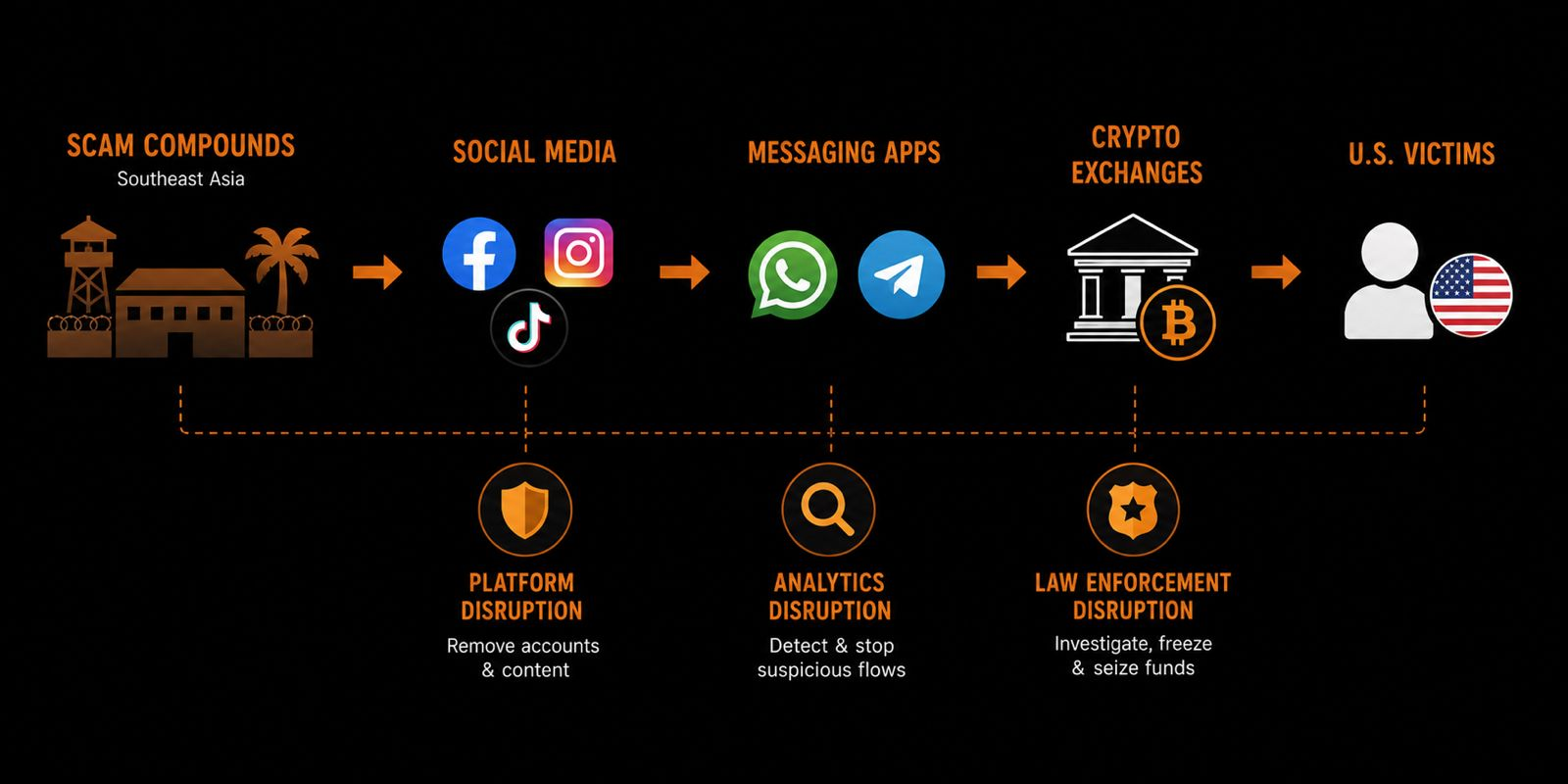
From 18 to 21 May in Washington, D.C., federal investigators briefed a hand-picked group of private sector players. The investigators came from the FBI, U.S. Secret Service and Homeland Security Investigations. Participants included Apple, Coinbase, Google, Meta, Microsoft, Silent Push, SpaceX, TRM Labs and Zenlayer. The briefings covered specific scam infrastructure tied to Chinese-linked transnational criminal organizations operating in Cambodia, Laos and Burma.
How Disruption Week Hit Pig Butchering Scams
Based on those indicators and their own internal data, participating firms voluntarily disrupted more than 1.4 million social media and email accounts. They also blocked malicious IP traffic. In addition, they decommissioned servers and hosting environments used to lure victims into fake crypto investment platforms.
The week produced immediate law-enforcement leads as well. Private platforms and government teams identified multiple scammers and scam platforms. Together, they referred cases for investigation in the United States. They also worked with Thai authorities on arrests of seven suspects. The Royal Thai Police Anti Cyber Scam Center opened new cases as well. Officials stressed that this is a first. Such a broad coalition of U.S. tech and infrastructure providers had never convened around a single fraud threat. The coalition also agreed to coordinated, voluntary disruption actions at this scale.
The Scale of Pig Butchering Scams
The backdrop is stark. According to the FBI’s Internet Crime Complaint Center, reported U.S. losses to crypto investment fraud rose from 3.96 billion dollars in 2023 to 5.8 billion in 2024. Losses then climbed to more than 7.2 billion in 2025. Crypto investment schemes accounted for 83 percent of reported investment fraud last year.
One government report cited by the Department of Justice estimates that global scam syndicates were stealing a conservative 64 billion dollars annually as of the end of 2023. Public reporting also shows scam-generated revenue approaching half of national GDP in some Southeast Asian jurisdictions hosting compounds.
These pig butchering scams combine human trafficking with industrial-scale social engineering. Workers are trapped in guarded compounds, facing beatings and electrocution. The social engineering drains the life savings of victims in the United States and beyond. For a deeper explanation, read our guide to how pig butchering scams work.
For additional background, DOJ’s dedicated Scam Center Strike Force portal details the wider initiative and highlights earlier actions. These include more than 700 million dollars in crypto restrained and seizures of over 500 scam websites. They also include a major Telegram channel used to funnel victims into fake platforms.
The Shift from Reacting to Pig Butchering Scams to Destroying Their Infrastructure
Disruption Week is less a one-off enforcement spectacle and more a signal of a structural shift. Cyber-fraud is now treated as a shared infrastructure problem rather than a series of isolated victim complaints. U.S. Attorney Jeanine Ferris Pirro’s office framed the Strike Force from day one as a vehicle to “bring private industry into the fight.” Disruption Week operationalizes that message. It turns internal platform data, hosting logs and blockchain intelligence into coordinated takedowns rather than siloed abuse tickets.
Disruption Week also reveals how enforcement narratives are shifting from purely reactive victim restitution toward proactive “infrastructure denial.” The Strike Force explicitly focuses on seizing U.S.-based facilities. It also targets the infrastructure that enables scams, including domains, servers, ISPs and social media accounts. Meanwhile, its crypto seizure team has already restrained more than 700 million dollars. It has also initiated forfeiture for tens of millions more.
This approach resembles counter-terrorism disruption doctrine applied to financial crime: break logistics, sever communications, and raise the cost of operating at scale. For CAT Investigators, this means prosecutors will likely give more attention to evidence packages that map infrastructure. Narrow victim narratives alone will carry less weight. Such infrastructure includes DNS, hosting, wallet clusters and comms channels. Our fraud and money laundering investigations trace exactly these links in pig butchering scams.
Disruption Week Compliance Implications for Pig Butchering Scams, And How to Get Ahead of Them
Build a Typology Library for Pig Butchering Scams
Develop and continuously update internal typologies specifically tied to pig-butchering schemes. Incorporate indicators from public DOJ releases, OFAC designations, and threat intel from partners such as TRM Labs and Chainalysis. These should cover on-chain patterns, such as layered transfers from addresses linked to Southeast Asian OTC desks. They should also cover behavioral signals, such as romance-style grooming patterns and investment app downloads following unsolicited contact. Finally, they should cover technical markers identified in enforcement materials, including domains, IP ranges, hosting ASNs and Telegram channels.Integrate law-enforcement and analytics feeds into case routing
Map your case management systems so that addresses, domains, or infrastructure tied to the Scam Center Strike Force investigations trigger enhanced due diligence or fast-track escalation. This is better than standard queue handling. Where possible, link to open-source indicators. Examples are those referenced on the DOJ Scam Center Strike Force page or in OFAC’s SDN updates. That way, investigators can quickly correlate internal alerts with public enforcement context.Formalize your own “disruption weeks” with partners
Use Disruption Week as a model. Convene internal and external stakeholders to run targeted disruption sprints against a defined scam typology. These stakeholders include fraud, AML, cyber, product, legal, plus key vendors. Pre-agree metrics such as number of accounts disabled, transactions blocked, or wallets flagged to law enforcement. Then measure the week’s output against your ordinary baseline. This not only reduces live exposure. It also produces evidence that you are meeting emerging expectations around proactive public-private cooperation.Strengthen off-ramp and recovery playbooks
The Strike Force’s crypto seizure team emphasizes asset recovery, not only disruption. Financial institutions and VASPs should develop clear playbooks for freezing suspicious outbound transfers linked to scam indicators. The playbooks should also cover preserving logs and chain of custody. In addition, they should cover packaging evidential reports suitable for DOJ, FBI or local law-enforcement engagement. Embedding blockchain analytics outputs directly into SAR or STR narratives will reduce friction. It will also increase the likelihood that your freezes translate into actual recoveries.Update customer-facing education with realistic threat models
DOJ press materials underscore that many victims are groomed over months. They are convinced they are investing in legitimate crypto products. Then they attempt withdrawals and find their accounts frozen or inaccessible. Instead of generic “never send money to strangers” advice, institutions should embed very specific pig-butchering scenarios into in-app warnings, onboarding flows and campaign content. This matters most when customers move unusually large sums into newly opened exchange accounts or high-risk jurisdictions.Prepare for scrutiny on inaction
Once large platforms demonstrate that they can identify and disrupt over a million scam accounts in a single week, it becomes harder for other ecosystem participants to argue that similar action is impossible. CAT clients should assume that regulators will increasingly view failure to act on known indicators as a governance issue, not a technical limitation. They should document both their technical constraints and their mitigation plans for pig butchering scams. For related reading, see our report on the House probe into China-linked scam compounds, or contact our team for support.Source
- DOJ – Scam Center Strike Force Announces Results of U.S. & Private Industry “Disruption Week”
- DOJ – Scam Center Strike Force overview and related news
- DOJ – New Scam Center Strike Force Battles Southeast Asian Crypto Investment Fraud Targeting Americans
- TRM Labs – The Scam Center Strike Force: A Whole-of-Government Response to Global Crypto Fraud
- Chainalysis – U.S. Launches New Strike Force to Combat 10 Billion Dollar Scam Industry