
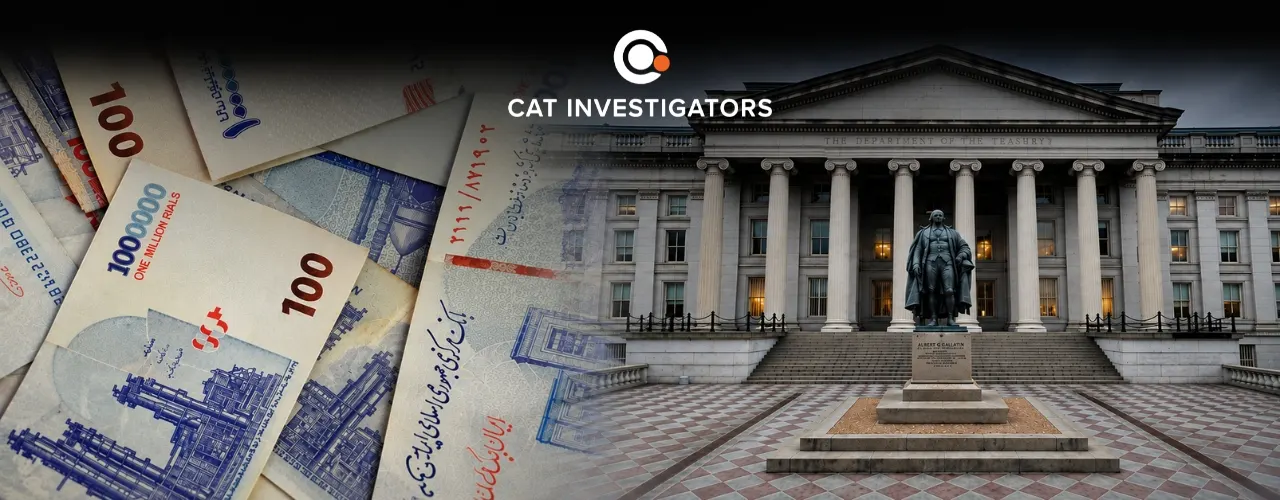
Operation Economic Outcast combines new sectoral authorities, entity designations and tightened compliance expectations for businesses with Iran-linked exposure.
A Wider Enforcement Framework
On 23 August 2026, the U.S. Department of the Treasury launched Operation Economic Outcast, a coordinated campaign designed to restrict the Iranian regime’s access to oil revenue, international procurement channels and financial services.
The package includes nearly 60 designations of entities, individuals and vessels connected to Iranian military procurement, cyber activity, petroleum trade and sanctions-evasion networks.
The central change is structural. OFAC issued sectoral determinations under Executive Order 13902 covering five areas of the Iranian economy: digital assets, technology, gold, aviation and shipping. This gives OFAC wider scope to designate foreign persons that operate in, or provide services supporting, those sectors.
Treasury also suspended several general licences under the Iranian Transactions and Sanctions Regulations. Those licences had previously permitted certain remittance payments and limited Iranian access to U.S. cultural and academic systems.
Secondary-Sanctions Risk Increases
The announcement is directed at more than U.S. companies. Treasury said foreign entities that facilitate money laundering or sanctions evasion for Iran risk losing access to the U.S. financial system.
It also warned that foreign financial institutions may face secondary sanctions when knowingly facilitating significant transactions for persons designated under the relevant authorities.
This approach matters because Iranian networks often operate through service providers outside Iran. Freight brokers, ship managers, bunkering providers, payment intermediaries, sourcing agents and commodities traders can become sanctions touchpoints even when their immediate counterparties appear non-Iranian.
For compliance teams, nationality alone is therefore an unreliable risk indicator. Ownership links, transaction purpose, trade routes, vessel history, end users and payment patterns require equal scrutiny.
Digital Assets Move Centre Stage
The designation of UAE-based Ukrainian national Ivan Obukhov is particularly relevant. Treasury alleges that Obukhov processed more than $100 million in cryptocurrency payments since 2023 to facilitate oil sales for the IRGC-Qods Force, while also assisting in the purchase of vessels later used in sanctions-evasion activity.
The package also includes Iranian cyber actor Arman Kahzadian, who Treasury alleges obtained control of a Bitcoin wallet containing more than $30,000 in 2023.
The designation shows how blockchain investigations, cyber-enabled theft and sanctions screening increasingly overlap.
Maritime and Trade Indicators
The maritime element remains extensive. Treasury designated brokers, bunker suppliers, vessel-management companies, commodities traders and five vessels alleged to have moved Iranian oil or petroleum products.
These include QUANTUM HOPE (IMO 9233650), VOYAGE ELITE (IMO 9286138), SIFRA (IMO 9185346), G SILVER (IMO 9139696) and TELA (IMO 9189110).
In addition, OFAC issued updated guidance on sanctions risks linked to Iranian demands concerning shipping in the Strait of Hormuz. That development should prompt shipowners, charterers, insurers, commodity traders and financial institutions to assess whether operational decisions in the region could create sanctions exposure.
The release also points to recurring transnational patterns. Treasury identified alleged facilitators and corporate structures spanning the UAE, Hong Kong, China, Singapore, Malaysia, Switzerland, the United Kingdom and other jurisdictions.
Implications for Investigations
These recent designations underscore a fundamental investigative tenet: while mandatory, screening against sanctions lists remains insufficient on its own. Risk often resides within the connective tissue between entities rather than in a singular, identifiable name.
A robust investigative review should integrate:
- Control structures and beneficial ownership, adhering to the OFAC 50 Percent Rule;
- Digital wallet interactions, exchange exposure, counterparties, and fiat conversion patterns;
- Maritime records including IMO history, vessel ownership, flag shifts, and ship-to-ship transfer red flags;
- Financial flows involving logistics providers, bunker suppliers, sourcing agents, and commodity traders;
- Trade documentation designed to mask product origins, final destinations, or end users.
Treasury maintains that any entity owned 50 percent or more, whether directly or indirectly and regardless of individual or aggregate holdings, is considered blocked. Consequently, these entities may present significant exposure even if they are absent from the SDN List by name.
Actions for Compliance Teams
Organizations with operational links to technology supply chains, trade finance, commodities, shipping, or digital assets should initiate immediate protocols:
- Re-evaluate vessels, beneficial owners, counterparties, and customers against the updated OFAC designations;
- Detect potential nexus points within the five Specified Sectors: aviation, gold, shipping, technology, and digital assets;
- Audit transactions and digital wallets for indirect links to shadow-fleet networks or IRGC-related petroleum trade;
- Update internal controls for high-risk trade routes and payment corridors utilized by oil-revenue and procurement facilitators;
- Implement enhanced due diligence when payment purposes, maritime movements, or corporate ownership lack independent verification;
- Escalate activity linked to opaque crypto-to-fiat conversions, sensitive technology acquisition, bunkering, or ship-to-ship services;
- Maintain blockchain and documentary evidence to substantiate risk assessments and potential regulatory filings.
This latest OFAC intervention represents more than a routine list expansion.
It signals a strategic broadening of the Iran-related enforcement perimeter, placing international maritime services and digital-asset enterprises squarely within its crosshairs.