

On the effective date of Federal Law No. 282-FZ, Sber announced crypto-based cross-border payments for corporate clients. The development deserves attention not as a retail-crypto story, but as a potentially institutionalised settlement channel operating at the intersection of Russian law, sanctions pressure and foreign financial infrastructure.
Russia’s Federal Law No. 282-FZ, On Digital Currencies and Digital Rights, is frequently described as a long-awaited crypto-regulation law. That description is incomplete.
The more consequential development is how quickly the new legal framework was followed by a practical payment-service announcement from Sber, Russia’s largest bank.
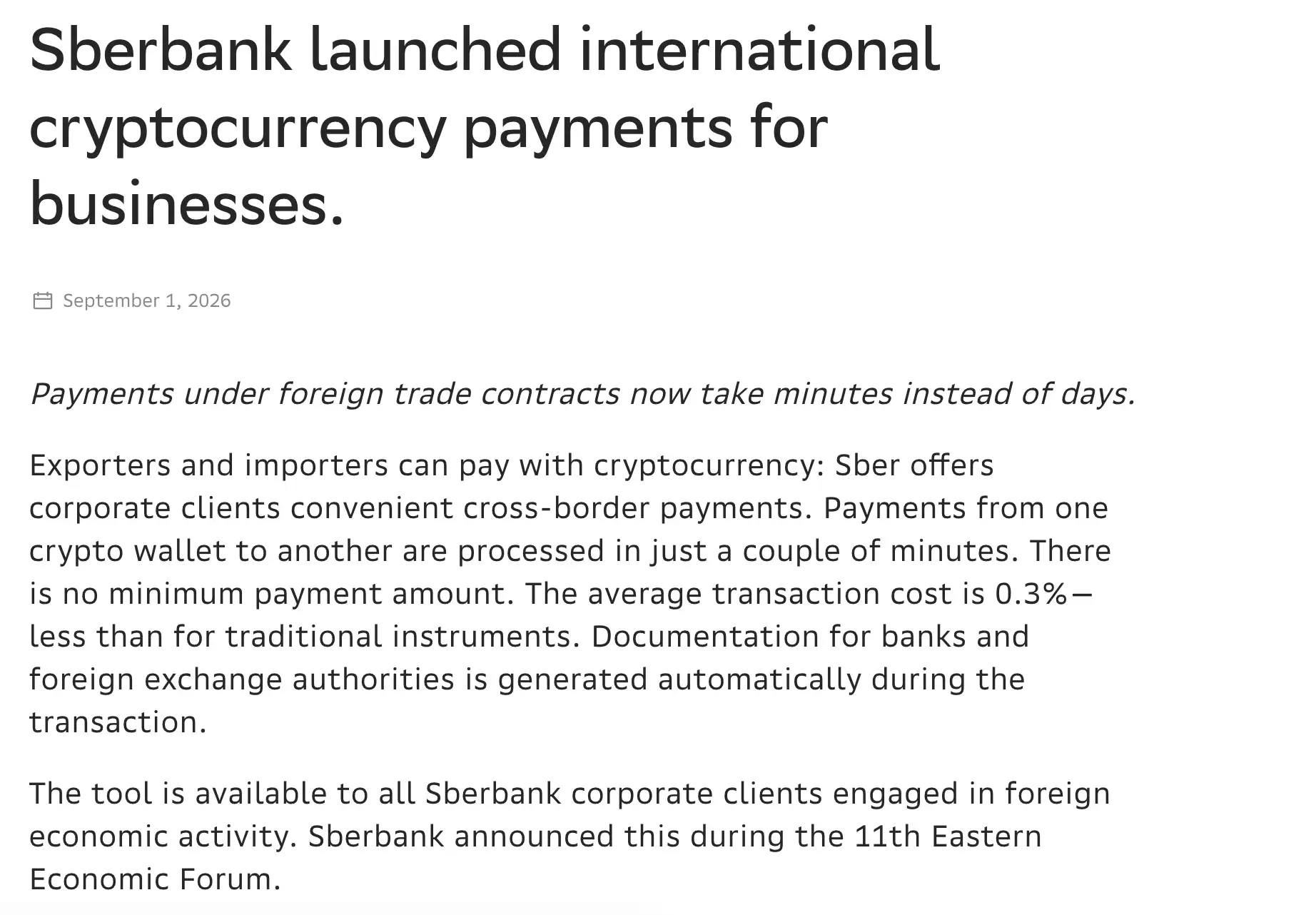
On 1 September 2026 – the date most of the law’s provisions entered into force Sber said it had launched cryptocurrency-based cross-border settlement for corporate customers engaged in foreign trade.
The law’s central bargain
Federal Law No. 282-FZ does not elevate crypto to the status of money but defines digital currency as property-rather than sovereign currency or legal tender-and then draws a sharp line between domestic and cross-border use. See Article 2(1)(1) for the legal definition of digital currency and its classification as property.
The domestic rule is restrictive. Under Article 1(6), digital currencies and digital rights generally may not be accepted in Russia as payment, counter-performance or another form of consideration for goods, work, services, information or intellectual-property rights.
The exception is strategically important. Article 1(7)(1) permits the use of a digital currency or digital right as payment or other consideration under a foreign-trade contract concluded between a Russian resident and a non-resident.
The law also contains other narrower exceptions, including the payment of rewards in connection with mining and payment of fees required for the operation of information systems. See Article 1(7)(2)-(3).
This is the statute’s central bargain: crypto remains unsuitable for ordinary domestic commerce, but it can be used where Russia has a strong policy interest in preserving economic functionality beyond its borders.
That distinction should frame any sanctions analysis. The law creates a domestic legal rationale for foreign-trade crypto settlement. It does not immunise a transaction from EU, UK, US or other sanctions, export-control or AML obligations.
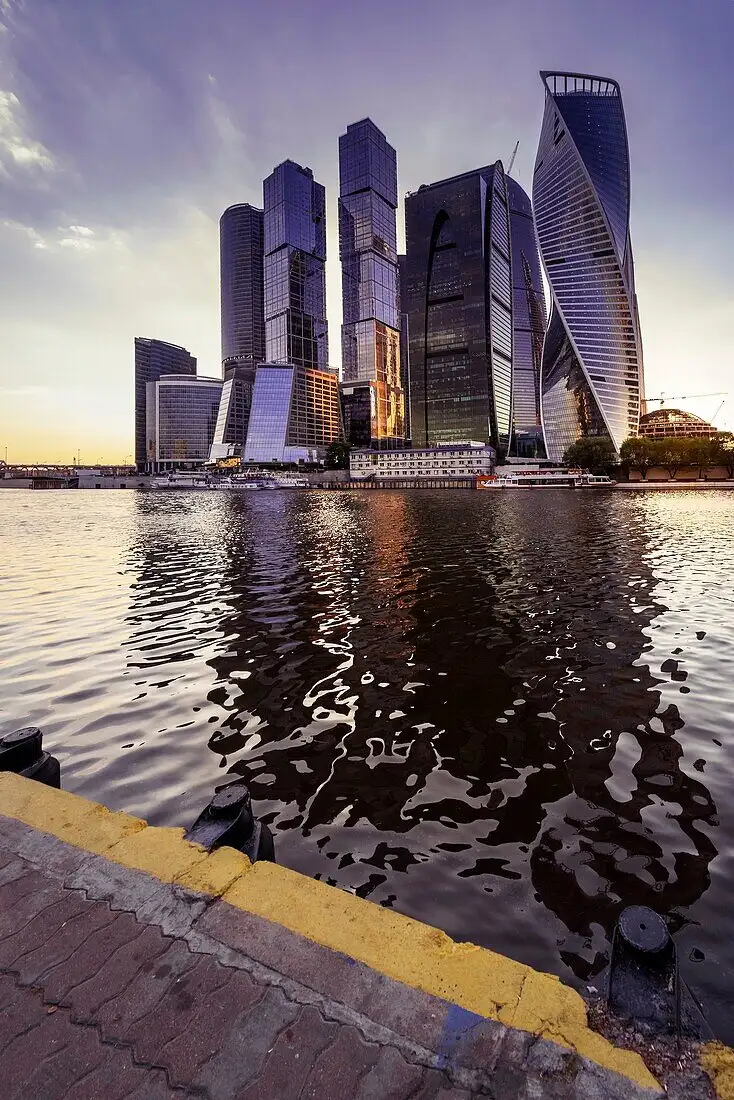
Moscow City, Russia’s main crypto financial district and a key hub for banks, corporate services and cross-border financial activity.
Sber operationalises the foreign-trade exception
Sber’s 1 September announcement is the key operational development.
According to it, the bank launched cryptocurrency-based international payments for corporate clients involved in foreign economic activity.
It described wallet-to-wallet transfers completed within minutes, no minimum transaction threshold, average fees of approximately 0.3%, and automated preparation of documents for banking and currency-control purposes.
The bank also said that it had tested the model since September 2024 in a Bank of Russia experimental legal regime and had seen demand for it.
Sber did not publish enough information to establish the complete structure of the service. It did not identify supported digital currencies, wallet-control arrangements, liquidity providers, foreign exchange partners, foreign custodians, participating jurisdictions, or its sanctions-screening methodology.
Those omissions are not peripheral. They are the central questions for any sanctions, AML or financial-crime assessment of the service.
It is important to note private providers had already promoted crypto solutions for external economic activity, while RSI Garant and Grinex advertised transaction-facilitation services for larger corporate clients.
A7A5 should be seen in the same context. The stablecoin was used in cross-border operations involving Russia-linked flows – not simply as a trading asset, but as part of a broader settlement infrastructure spanning wallets, exchange access, OTC liquidity and payment intermediaries.
Why the integration layer matters
Sanctions enforcement has traditionally benefited from the friction created by conventional international payments. Banks hold customer records, payment messages identify counterparties, intermediaries create audit trails, and sanctions filters can stop or delay value before it moves.
Crypto does not eliminate those controls by itself. But it can separate the payment instruction from the payment rail.
A Russian corporate customer may prepare documentation within a bank-supported workflow, while the value itself travels via a stablecoin (USDT, USDC) or other digital asset through self-hosted wallets, third-country payment agents, OTC brokers, foreign exchanges or liquidity providers.
The transaction may have a documented purpose under Russian currency-control rules while remaining opaque or only partially visible to the foreign financial institutions exposed to the settlement chain.
| Layer | What may be visible | What requires investigation |
|---|---|---|
| Russian corporate workflow | Contract references, payer identity, accounting entries, currency-control documentation | Whether the stated trade purpose is genuine; whether the buyer, seller or end-user is concealed |
| On-chain transfer | Wallet addresses, token, amount, timestamp, transaction path, bridge or swap usage | Who controls the wallets; whether funds relate to a specific commercial obligation |
| Liquidity layer | Exchange deposits, OTC movements, stablecoin issuance or redemption patterns | Identity of market makers, payment agents, OTC desks and cash-out entities |
| Trade layer | Invoices, shipping records, customs entries, supplier details | Goods classification, end use, beneficial ownership, sanctions or export-control exposure |
| Third-country layer | Locally incorporated entities, foreign banks, CASPs and money-service businesses | Whether the entity is genuinely independent or functions primarily as a Russia-facing settlement intermediary |
The law creates an intelligence map
The statute should be read not only as regulation, but also as an indication of where Russia expects important digital-asset activity to concentrate.
Article 1(3) limits the organisation of digital-currency circulation in Russia to specified professional categories, including trading organisers, brokers, trustees, digital depositories, digital-currency exchange organisations and clearing organisations. The details of the regulated ecosystem appear across Articles 14-18.
For investigators, these categories identify potential points of concentration:
- Trading organisers and brokers may centralise orders, client identity, instructions and market access.
- Digital-currency exchange organisations may become conversion points between roubles, stablecoins and other cryptoassets.
- Digital depositories and trustees may hold records linking clients, assets, account relationships and address identifiers.
- Clearing organisations may connect contractual obligations with final settlement.
- Foreign-trade users may generate a combination of trade documents, payment instructions and blockchain artefacts.
The law also establishes separate rules for transactions and operations in digital currency. Article 30 is central to the resident-transaction framework, while Article 31 addresses conditions for completing transactions and operations.
One technical point deserves emphasis: the statute relies on the Russian currency-law definitions of “resident” and “non-resident.” Under Article 2(2), these terms carry the meanings assigned in Russia’s currency-control legislation. They should not be conflated with tax residence, nationality or place of incorporation.
The published framework is also not necessarily the complete operational perimeter. Article 1(18) permits the Russian government, in agreement with the Bank of Russia and the competent security authority, to establish a special regime for digital-currency circulation that differs from the ordinary rules.
Stablecoins: utility and vulnerability
The law’s treatment of “foreign digital instruments” is likely to be more important in practice than many of its formal market-structure provisions.
Article 2(1)(20) defines a foreign digital instrument as property representing contractual or other rights, issued under foreign law through an information system organised outside Russian law. The definition excludes foreign securities.
The statute does not expressly name or approve USDT, USDC or another stablecoin. It would therefore be inaccurate to claim that it legalises a particular stablecoin.
But the category is relevant because many stablecoins are not merely decentralised bearer assets: they involve issuers, contractual arrangements, redemption mechanics, reserves and administrative controls.
They also remain vulnerable at points that matter.
- Major centralized stablecoins can be frozen or blacklisted by issuers.
- Stablecoin liquidity often depends on regulated or identifiable exchanges, OTC desks and market makers.
- Large-scale utility depends on redemption, banking relationships and reliable conversion into usable fiat value.
- Cross-chain movement may obscure a path, but it does not guarantee that a later cash-out or redemption point will accept the funds.
This is the enforcement paradox: the same centralised features that make stablecoins convenient for commercial settlement may offer better disruption opportunities than decentralised assets-if authorities, issuers, exchanges and banks intervene before value disperses through self-hosted wallets, P2P markets, bridges and informal cash-out networks.
Mining: visibility at the perimeter, opacity beyond it
Russia’s mining provisions are not merely industrial policy. They may create a partial attribution layer in a sector that has historically produced relatively weak transparency.
Article 3 provides the core framework for mining and mining infrastructure. It addresses entry in relevant registers, conditions for participation and related requirements. Article 3(11) requires miners, including mining-pool participants, to report mined digital currency and address identifiers to the Federal Tax Service. Under Article 3(12), the tax authority may share relevant information with the competent AML/CFT authority and the Bank of Russia.
The government is also authorised to prohibit or restrict mining in defined areas under Article 5(1).
These rules could create useful investigative signals:
- Freshly mined assets may become linkable to declared entities or identifiable infrastructure.
- Mining pools may become attribution hubs for Russian-connected hash power and payout flows.
- Corporate records, physical infrastructure, electricity consumption, known pool addresses and blockchain data may be compared for consistency.
- The difference between declared mining, expected energy consumption and observed movements of newly issued assets may identify anomalies worth investigating.
But the registry should not be mistaken for a comprehensive view of Russian mining. Actors seeking to avoid taxes, conceal ownership, monetise high-risk proceeds or evade enforcement have strong incentives to use foreign pools, nominee structures, hosted infrastructure and frequently changing payout addresses.
What to monitor next
The law establishes an architecture, not a finished market. Its impact will depend on Bank of Russia regulations, registration decisions, supervision, product design and the willingness of foreign counterparties to support Russia-linked flows.
Sanctions and compliance teams should watch:
- Bank of Russia registers, licences and public disclosures concerning crypto intermediaries, digital depositories and trading venues.
- Implementing rules under Article 30 and Article 31, particularly the conditions governing transactions by residents and the involvement of foreign counterparties.
- The technical structure of Sber’s foreign-trade crypto-payment service: whether it acts as principal, broker, payment agent, wallet provider, documentation layer or some combination of these roles.
- The assets, chains, wallet types, foreign counterparties, liquidity providers and off-ramp arrangements used in Sber-supported flows.
- The form and information content of the service’s automated currency-control documentation, including whether it records wallet identifiers, transaction hashes, beneficiary information, invoice references or contract data.
- Early adoption by trade sectors exposed to export controls, dual-use procurement, sanctioned-industry supply chains or high-risk jurisdictions.
- Mining registries, mining-pool clusters, address-reporting patterns and discrepancies between declared operations and physical capacity.
- Foreign digital instruments that become operationally relevant to Russia-linked settlement, including stablecoin-like products.
- Russia-linked crypto providers that reappear through rebranding, successor platforms, third-country incorporation, changes in technical infrastructure or nominee ownership.
- Shifts in stablecoin concentration, bridge usage, exchange deposit patterns and cash-out geographies following sanctions actions.
This article is an analytical overview, not legal advice. It distinguishes between what Federal Law No. 282-FZ expressly provides, what Sber publicly announced, and the broader sanctions-enforcement implications that follow from the interaction of those developments with existing cross-border payment restrictions.