
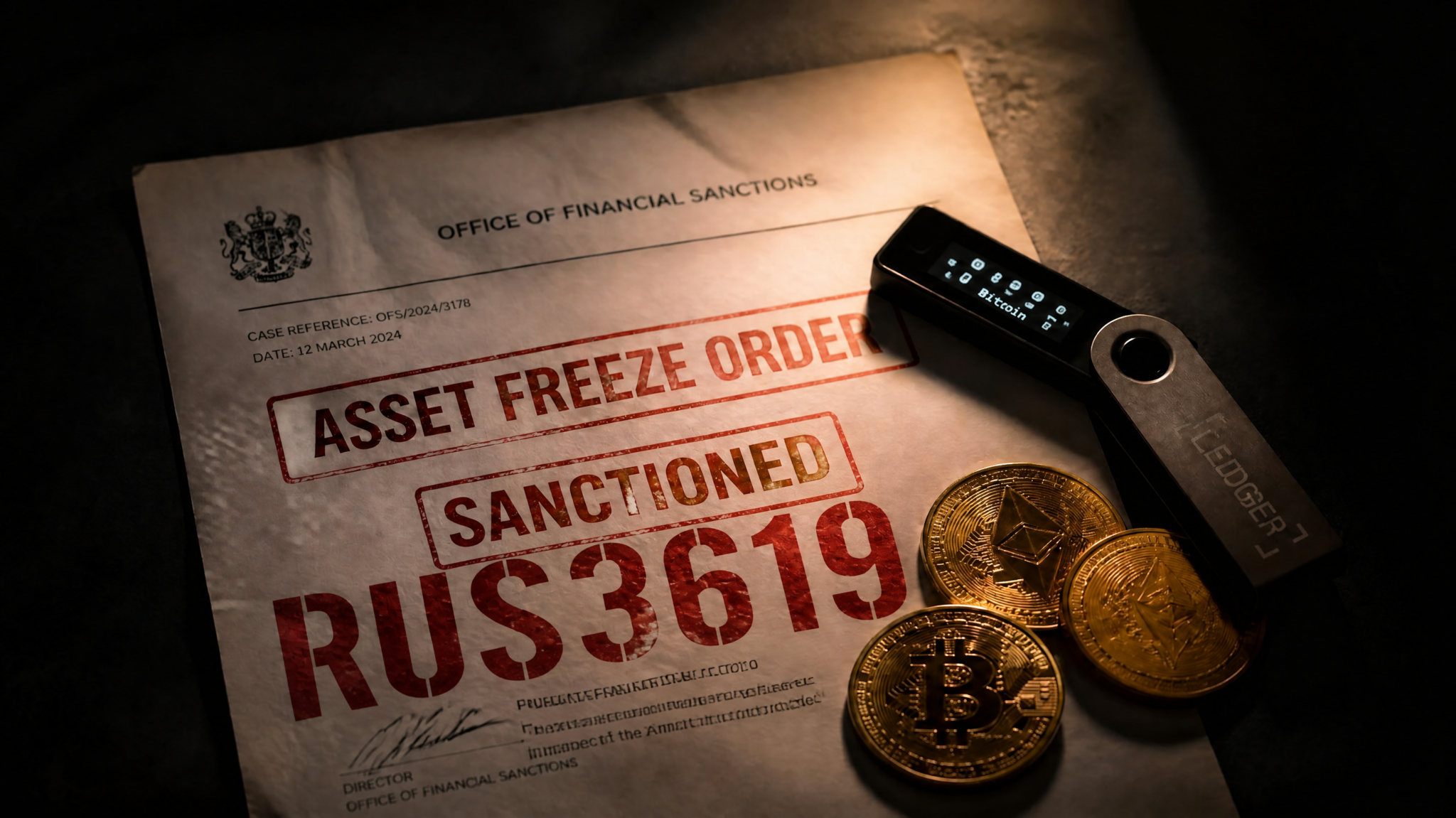
A new UK sanctions package goes after the Kremlin-linked A7 crypto‑banking network, freezing a Kyrgyz bank and designated entities like RUS3619 that sit at the core of Russia’s sanctions‑evasion machinery.
How the A7 Crypto Network Became Critical Infrastructure for Russia’s War Economy
On 26 May 2026, the UK government announced a new package of Russia‑related sanctions aimed at cryptocurrency platforms, regional banks and financial intermediaries it identifies as “shadow financial systems” supporting Moscow’s war economy, and simultaneously updated the UK Sanctions List under The Russia (Sanctions) (EU Exit) Regulations 2019.
The measures focus on a Kremlin‑linked structure described as the A7 network, together with a Kyrgyz bank and associated entities, which officials say route funds for Russia outside traditional correspondent‑banking channels and help finance procurement in spite of Western restrictions.
From the date of designation, all funds and economic resources of the listed parties within UK jurisdiction are frozen, and UK persons are prohibited from making funds or economic resources available to them, directly or indirectly, unless a licence is granted.
This action builds on earlier UK measures in August 2025 that first publicly named the A7 ecosystem, when London designated a Kyrgyz institution (Capital Bank), its director Kantemir Chalbayev, and several Russia‑facing cryptoasset exchanges for facilitating rouble‑linked transactions designed to circumvent sanctions.
At that time, UK and partner reporting highlighted a rouble‑backed token associated with A7 that had processed roughly 9.3 billion USD in transactions over four months on a dedicated exchange, underscoring the scale of flows being pushed through these alternative rails rather than through conventional banking.
The May 2026 package goes further by treating A7 not as a single token or platform but as a piece of core infrastructure for Russia’s financial resilience and attempting to cut multiple points in the network-exchanges, banks and vehicles registered in jurisdictions such as Kyrgyzstan, Georgia and the UAE-in one coordinated move.
In the technical architecture of sanctions, these decisions are reflected in new entries on the UK Sanctions List, including the designation with identifier RUS3619 under the Russia regime. The public record for RUS3619 specifies the regime, list type and designation date (26 May 2026), confirming that it is now an asset‑freeze target that must be captured by banks, funds, insurers and digital‑asset platforms when screening payments, relationships and onboarding flows.
Why A7 Changes How Sanctions Risk Shows Up in Files
For CAT Investigators’ clients, the A7 action is less a single sanctions headline and more a case study in how regulators are now mapping and attacking Russia’s sanctions‑evasion infrastructure at the network level.
The UK is signalling that rouble‑linked tokens, regional banks in jurisdictions like Kyrgyzstan and Russia‑facing exchanges are not marginal anomalies but deliberately constructed payment rails that can be traced, designated and cut when they support the Kremlin’s war machine.
In practical terms, sanctions exposure increasingly appears through repeated contact with a tight cluster of intermediaries-banks, OTC brokers, exchanges and shell entities tied to A7‑type systems—rather than only through direct dealings with well‑known Russian SOEs, defence firms or oligarch names.
The A7 case also exposes the limits of static, name‑only screening architectures.
When a rouble‑backed token can move 9.3 billion USD in four months, and a single global exchange‑plus‑bank corridor can channel more than 1.5 billion USD in flows linked to Russian interests before being publicly called out, the principal risk is not one missed sanctions‑list “hit” but the absence of structural pattern recognition across counterparties and channels.
Forensic analysis therefore needs to connect dots across jurisdictions and asset classes: recurring use of Kyrgyz banks, rouble‑pegged tokens, specific Russia‑facing exchanges, and vehicles registered in hubs like the UAE or Georgia should be treated as indicators of network‑level exposure to A7‑style systems even before every individual node is formally designated.
For institutions sitting at the crypto‑traditional finance boundary, the 26 May notice and the RUS3619 listing function as a live test of whether their sanctions‑risk architecture can keep pace with this shift toward distributed, token‑enabled evasion networks.
Going forward, compliance teams will be judged less on whether they can block obviously named actors and more on whether they can identify, escalate and, where necessary, exit relationships that are structurally entangled with A7‑type networks-even when only a subset of nodes, like RUS3619, currently appear on official lists.
Where to Focus and What Not to Miss
- Re‑tool sanctions models around A7‑type indicators: Integrate the specific jurisdictions, rouble‑linked token behaviour and Russia‑facing exchanges highlighted in the UK materials into sanctions‑risk scoring, and flag clients or counterparties that repeatedly touch this cluster for enhanced due diligence.
- Hard‑wire the new UK listings, including RUS3619: Confirm that screening engines are pulling the latest UK Sanctions List and Russia‑regime updates, and test that payments, relationships and trades involving RUS3619 or linked entities are correctly detected, blocked or escalated in line with asset‑freeze obligations.
- Build playbooks for crypto‑banking corridors: Develop dedicated investigative workflows for cases involving rouble‑anchored tokens, Kyrgyz or similar regional banks and Russia‑facing exchanges, including criteria for filing suspicious activity reports, exiting relationships or seeking legal advice on licensing where UK sanctions may apply.
- Re‑screen high‑risk books for hidden A7 exposure: For existing clients with known Russian nexus or elevated sanctions risk, run a retrospective review of transaction histories to identify repeat touchpoints with A7‑type infrastructure and escalate those cases for targeted investigation and, where appropriate, engagement with UK or allied enforcement partners.
Sources
- Reuters – “UK targets Russian crypto networks in latest sanctions”
- UK Government news release – “UK cracks down on backdoor Russian sanctions evasion with tough new measures”
- UK Sanctions List landing page
- UK Sanctions List entry – RUS3619 (Russia regime)
- Sanctions Notice, Russia (26 May 2026)
- UK Government background – “UK targets sanctions circumvention and crypto networks exploited by Russia”