
How Shelbit, Aban Tether and IRGC-Linked Flows Connect
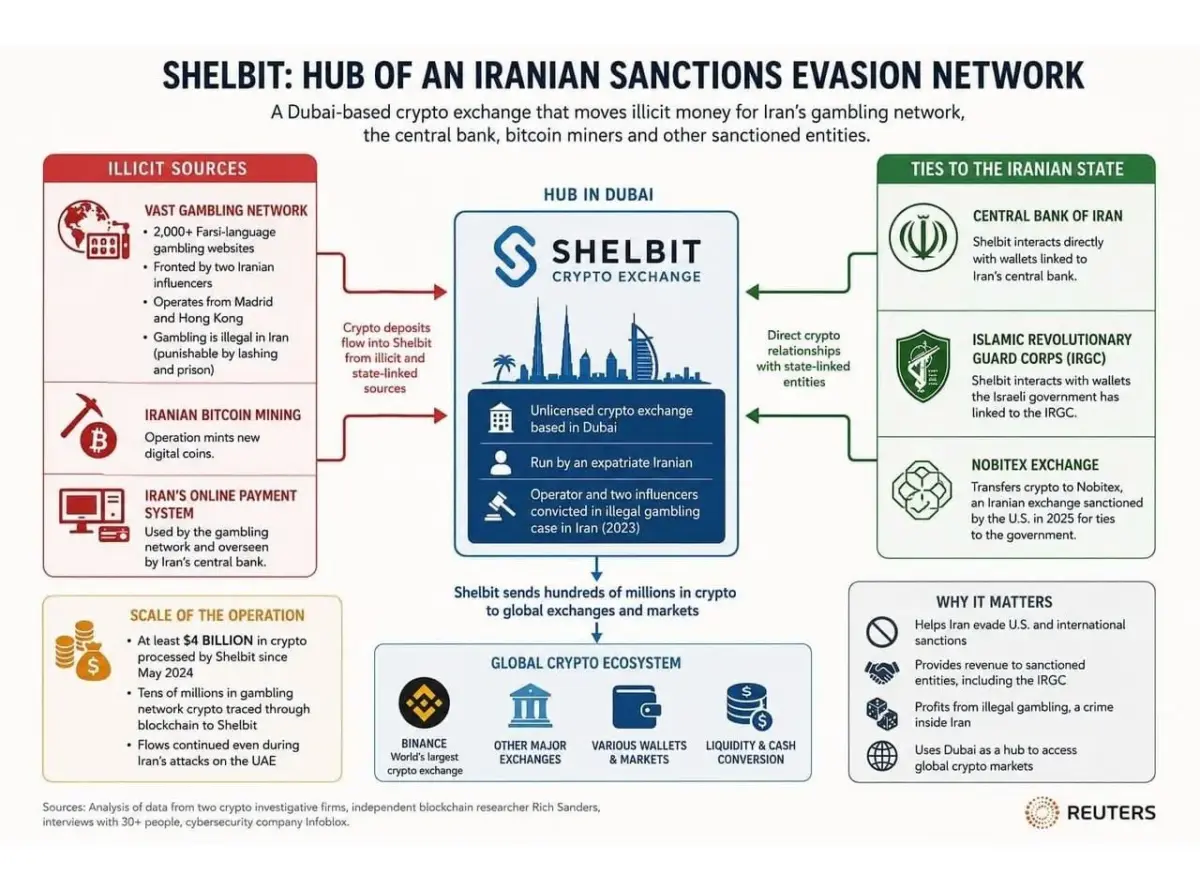
The U.S. Treasury’s Office of Foreign Assets Control (OFAC) has sanctioned Iranian digital-asset exchange Aban Tether, Georgia-based SHPS Shelbit, UAE-based Shelbit General Trading LLC, and several entities tied to Siavash Kayvanpour. The action targets what Treasury describes as a cross-border crypto-finance network used to support Iran’s Islamic Revolutionary Guard Corps (IRGC), move illicit funds, and evade sanctions.
OFAC designated Kayvanpour under Executive Order 13224 for materially supporting the IRGC and already sanctioned exchange Nobitex. Treasury states that IRGC-linked wallets sent more than $1 million in digital assets to Shelbit-associated addresses, while Shelbit addresses transferred more than $2 million back to IRGC-linked wallets. Wallets belonging to or controlled by Kayvanpour also sent more than $2 million to Nobitex.
The case extends beyond a single exchange. According to Treasury, Shelbit facilitated tens of millions of dollars in digital assets for a Persian-language online gambling network. This alleged link illustrates how gambling platforms, exchange services and corporate vehicles can combine to conceal source-of-funds information and blur the route between illicit activity and sanctioned beneficiaries.
The Network
OFAC’s designation list identifies entities and operational links in several jurisdictions. The structure is particularly relevant for compliance teams because legal entities, trading names, company-registration data and on-chain addresses all form part of the screening picture.
| Designated Party | Jurisdiction | Sanctions Context & Multi-Chain Identifiers |
|---|---|---|
| Siavash Kayvanpour | Iran / UAE | Designated under E.O. 13224 for IRGC and Nobitex facilitation. Identifiers include BTC, ETH, and TRON addresses. |
| SHPS Shelbit (Shelbit Exchange) | Georgia | Operational node in the Shelbit network. OFAC published linked BTC, ETH, TRON, and SOL identifiers. |
| Shelbit General Trading LLC | UAE | Commercial vehicle for Shelbit Exchange; designated under E.O. 13224 for supporting sanctioned activity. |
| Shelbit Technologies Ltd sp. z o.o. | Poland | European legal entity within the Kayvanpour-led cross-border crypto-finance structure. |
| Crypto Home DMCC | UAE | Designated entity controlled by Kayvanpour. Identifiers cover BTC, ETH, BNB, and TRON chains. |
| NFT Home DMCC | UAE | Blocked as part of the Kayvanpour network under the most recent OFAC designation update. |
| Aban Tether Exchange | Iran | Sanctioned under E.O. 13902 for providing financial services within the Iranian economy. |
Why It Matters
This action demonstrates why sanctions controls cannot rely only on a customer’s declared country of residence or a single name-screening result. Treasury’s findings connect individuals, legal entities, commercial brands, exchange services, gambling activity and wallets across Iran, Georgia, the UAE and Poland.
For virtual-asset service providers, payment firms and financial institutions, the critical investigative question is not simply whether a wallet appears on a sanctions list. It is whether transaction flows, beneficial ownership, counterparties or service-provider exposure create a connection to a designated person or a blocked entity under OFAC’s 50 Percent Rule.
Treasury states that entities owned, directly or indirectly, 50 percent or more in aggregate by blocked persons are also blocked, even where the entity itself is not separately named.
The inclusion of on-chain identifiers matters operationally. OFAC listed multiple addresses connected to Kayvanpour, SHPS Shelbit and Crypto Home across Bitcoin, Ethereum, TRON, BNB Chain and Solana, signalling the importance of multi-chain monitoring rather than a Bitcoin-only screening approach.
Investigative Perspective
The Shelbit case is a strong example of structural opacity rather than a straightforward wallet-to-wallet sanctions breach.
An investigator may encounter a transaction that appears to involve a non-Iranian company or an apparently separate exchange brand. However, corporate control, historic regulatory action, common management, address clustering and transaction exposure may reveal a materially different risk profile.
Treasury also noted that the UAE’s Virtual Assets Regulatory Authority took enforcement action against Shelbit General Trading in January 2025 and July 2026, and against Crypto Home in January 2025.
Those events did not prevent the entities from becoming part of the later OFAC designation, underlining the need to treat adverse regulatory history as an enhanced-due-diligence trigger rather than a closed compliance event.
Aban Tether presents a separate exposure pattern. Treasury states that it processed millions of dollars in transactions involving previously sanctioned Iranian exchanges, including Nobitex, Wallex, Bitpin and Ramzinex.
That alleged activity highlights the value of counterparty-exposure analysis and indirect-flow tracing, especially where direct sanctions-list matches are absent.
Actionable Takeaway
Compliance teams should immediately refresh sanctions-screening datasets using the identifiers published in OFAC’s August 7 update. Screening should cover legal names, aliases, addresses, registration information, beneficial-ownership connections and all listed wallet addresses.
- Audit Historical and Current Exposure Patterns: Conduct an immediate retrospective review of institutional links to Shelbit, Aban Tether, Crypto Home, NFT Home, and their associated aliases to identify legacy or active risk.
- Deploy Multi-Chain Transactional Intelligence: Execute comprehensive, multi-hop blockchain tracing for all provided identifiers across Bitcoin, Ethereum, TRON, BNB Chain, and Solana to unmask indirect connections to the designated network.
- Implement Escalation Playbooks for Structural Risk: Transactions demonstrating exposure to Iranian exchanges, Persian-language gambling platforms, or opaque corporate vehicles in the UAE and Georgia must be prioritized for enhanced scrutiny.
- Reevaluate Polish Jurisdictional Exposure: Perform a dynamic risk reassessment of counterparties tied to Warsaw-registered Shelbit Technologies Ltd sp. z o.o., specifically targeting beneficial ownership, common directorships, and regional payment flows.
- Strictly Enforce the 50 Percent Rule: Before authorizing high-risk settlements, institutions must ensure that potential counterparties are not blocked through aggregate ownership by designated entities and seek expert legal counsel where exposure remains ambiguous.
For U.S. persons, property and interests in property of designated persons that are in the United States or within U.S. persons’ possession or control must be blocked and reported to OFAC.
Treasury also warns that non-U.S. persons may face sanctions exposure for certain transactions involving designated parties or for conduct that causes U.S. persons to breach U.S. sanctions rules.